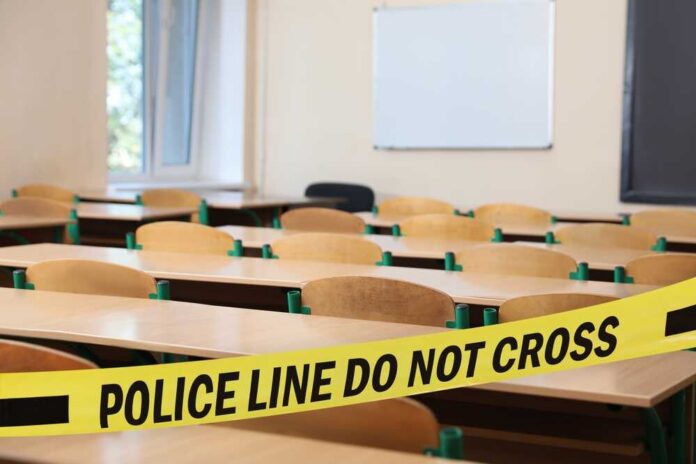
Two boys with pistols walked into a Philippine classroom, and in under a minute, they exposed how fragile our faith in “safe schools” really is.
Story Snapshot
- Two students, ages 14 and 15, are accused of killing three classmates and injuring seven more in a rare Philippine school shooting.
- Police say the teens blamed school bullying, while also admitting “red flags” in their behavior were missed before the attack.
- The guns appear to have come from adults who should have known better, raising questions that go far beyond one campus gate.
- Early official stories focus on hurt feelings and “grudges,” but the deeper fight is over accountability: kids, schools, or the system around them.
A quiet morning ends with gunfire and chaos
San Jose National High School in Tacloban City started that Monday like any other. More than 1,500 students filled classrooms at the government-run campus when two teenagers, 14 and 15 years old, walked in with handguns and opened fire on their classmates.[3]
Three students died. Seven more were wounded, most of them girls, according to police briefings.[3] Panicked children ran for their lives, some getting hurt just trying to escape.[1] For a country that rarely sees school shootings, this was a shock to the system.[5]
Police say one suspect was caught on school grounds within minutes. The other fled and hid in a nearby house before officers, tipped off by residents, tracked him down and arrested him.[3][6]
Both suspects were students at the school. Officers recovered two pistols at or near the scene, a .38 caliber revolver and a 9 millimeter handgun, which have now been sent for forensic tests.[5] Investigators later counted around 40 spent shells, a grim map of where fear tore through that room.[1]
At least three people were killed and five others injured in a school shooting in Tacloban, Philippines. https://t.co/vVVljK3dyk
— Breaking911 (@Breaking911) June 22, 2026
Bullying, grudges, and the rush to a clean motive
From the first hours, police framed the shooting around one word: bullying. Regional police chief Jason Capoy said the boys, who were close friends, told officers they had been bullied at school when first questioned.[3][6] Another police official described the motive as a “grudge” tied to bullying.[1]
That fits a familiar global pattern. When students attack a school, officials often settle quickly on a simple story about hurt pride and revenge. It calms the public: bad kids, clear motive, problem contained.
The facts are less tidy. Investigators admitted they still did not know if the supposed targets were even in the classroom when the shooting started.[1]
That matters. If no specific bully was there, the “grudge” explanation starts to look more like a label than proof. Officers also said questioning of the boys was still early when these bullying claims went public.[1]
No signed confession. No detailed timeline. Just two shaken teens and a system that badly wanted a reason it could explain in one sentence on the evening news.
Red flags, loose guns, and shared responsibility
While the bullying story grabbed headlines, another piece of the puzzle got less attention but carries heavier weight for adults. A national police spokesperson admitted that “red flags” in the boys’ behavior had been missed before the attack, and that the tragedy might have been stopped.[1]
That is a remarkable statement. It suggests teachers, classmates, or families saw warning signs but either did not act or were not heard. For those who believe in both personal responsibility and strong families, that should ring loud.
The guns raise even harder questions. Reports say one of the firearms was registered to a policewoman who is related to one of the suspects and is now in custody.[1]
Other accounts note that there was only a single guard on duty at multiple school entrances, which allowed the boys to carry the pistols inside unnoticed.[6]
That is not just a story about two angry teenagers. It is about adults who failed basic duties: securing your weapons, guarding your post, and watching your kids. Blaming “bullying” alone lets far too many grown-ups off the hook.
Rare shooting, global pattern, and what should change
Officials and reporters stressed that a school shooting like this is rare in the Philippines.[5] That is true, especially compared with the United States, where hundreds of school gun incidents have occurred in recent years and exposure to school shootings has tripled since Columbine.[11]
But rarity can breed complacency. When a society assumes “it cannot happen here,” alarms about unstable behavior, threats, or weapons at home get brushed aside as teen drama instead of early danger.
TRIGGER WARNING: Sensitive Content
Officials from the DepEd Central Office check on learners who were hospitalized following the shooting incident at San Jose National High School in Tacloban City on Monday, ensuring that their safety, welfare, and immediate needs are being… pic.twitter.com/0xlKLZER9d
— The Philippine Star (@PhilippineStar) June 22, 2026
Global research on school shootings shows most attacks are “targeted” and carried out by young males, often current or former students.[9] Handguns are the most common weapon. That fits Tacloban almost perfectly. The lesson is not that every troubled boy is a killer.
The lesson is that when you see the same risk pattern over and over, you stop treating each case as a shock and start building habits: secure guns at home, take credible threats seriously, track behavioral shifts, and give schools more than one guard to cover multiple gates.
Accountability, not theatrics, is what victims deserve
After the shooting, President Ferdinand Marcos Jr. ordered a thorough probe and told police to boost security in schools, workplaces, and public spaces.[2][3] Those are expected moves.
Yet without real transparency, they risk becoming political theater. The parents who buried their children do not need more slogans about “red flags.”
They need answers: who saw what, who failed to act, and who will be held to account. That includes the gun-owning relative, the school’s leadership, and yes, the shooters themselves.
A conservative view of justice starts with this: you do not trade away hard questions about adult failure for a neat story about teen bullying. Personal responsibility is not only for two boys in handcuffs.
It also belongs to every adult who left guns within reach, ignored warning signs, or treated school security like a box to tick instead of a shield to guard. The Tacloban shooting is a rare event. That is no excuse to treat it as a freak accident instead of a warning shot to fix what is clearly broken.
Sources:
[1] YouTube – Students seen crying after shooting at a high school in the …
[2] Web – Three killed and seven injured in Philippine school shooting – CNA
[3] Web – Three dead in Philippines high school shooting over bullying ‘grudge’
[5] Web – Two suspects in custody after shooting at high school in Philippines …
[6] Web – Philippines’ Marcos Orders Probe Into School Shooting That Killed …
[9] Web – At least three students were killed and five others wounded on …
[11] Web – 2 students in custody after shooting at high school in Philippines …