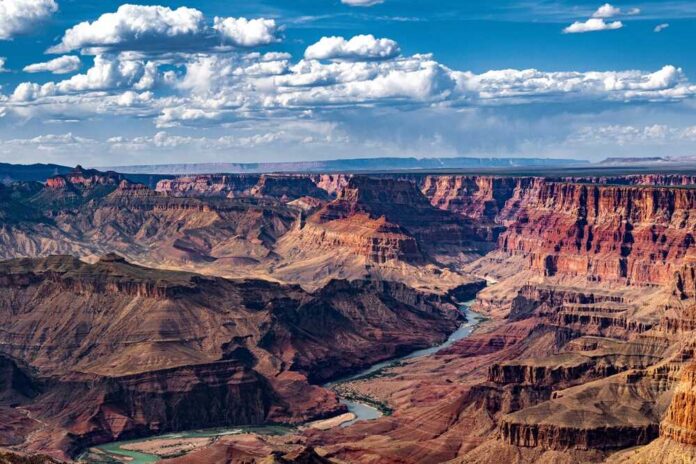
Lake Powell is now so low that one more bad year could turn Glen Canyon Dam from a power plant into a massive concrete wall with nothing to spin its turbines.
Story Snapshot
- Lake Powell is only about 35 feet above the level at which Glen Canyon Dam loses all hydropower.
- The reservoir is roughly 23% full and has dropped more than 30 feet in a single year.
- Federal managers are cutting water releases to slow the decline, but inflows are only about one-third of normal.
- Advocacy groups and media are pushing a crisis narrative, while federal agencies stay quiet on exact shutdown dates.
Lake Powell’s Level Is Now Inside The Red Zone
Lake Powell, the second-largest reservoir in the United States, sits around 3,524 feet above sea level, barely 34–36 feet above the minimum power pool at Glen Canyon Dam where hydropower must shut down. That gap used to be measured in hundreds of feet.
Now it is measured in yards, and each hot, dry month bites off a little more. Recent tracking shows the lake has fallen about 30 to 36 feet in a single year. At roughly 23% of capacity, Powell is hovering near the lowest levels ever recorded since it first filled in the 1960s.
Minimum power pool is not a fuzzy idea. Hydropower stops when the water surface drops to about 3,490 feet, because there is no longer enough pressure to safely spin the turbines.
Below that, Glen Canyon Dam is still a wall holding water, but it no longer makes electricity for homes and businesses across the West.
Experts who monitor this data daily warn that if current trends continue without strong snow years or major policy changes, Powell could hit a new record low within months. That puts the margin for error in the same range as one bad runoff season.
Lake Powell, the second-largest reservoir in the U.S. located in Arizona and Utah, is nearing critically low water elevation levels, the latest data shows.
Read more: https://t.co/tYDgXZ8PgR pic.twitter.com/qkqLYovE1l
— ABC News (@ABC) July 14, 2026
Emergency Moves Can Slow The Fall, Not Reverse It
Federal water managers at the Bureau of Reclamation have not been idle. Facing what they themselves describe as critically low conditions across the Colorado River system, they have cut planned releases from Lake Powell from roughly 7.5 million acre-feet to near 6 million acre-feet in the current operating year.
That is a huge shift in a system where every million acre-feet matters for cities, farms, and power generation. Forecasts for water year 2026 show unregulated inflow of just 3.27 million acre-feet, only about 34% of the historical average. In plain terms, far less is coming in than going out.
That imbalance has been building for decades. Studies of the Colorado River Basin show combined storage in Lake Powell and Lake Mead has dropped by over 30 million acre-feet since 2000, a decline of more than 40%. Climate and policy choices both play a role. Warmer temperatures shrink snowpack.
Legal promises based on wetter decades still demand water that no longer exists in the same amounts. Reclamation’s 24‑month studies now routinely discuss “critically low” scenarios and the risk of hitting power-and-even “dead pool” thresholds, where water can no longer flow through dams at all.
Who Is Shaping The Crisis Narrative And Why It Matters
While federal engineers publish numbers, they rarely speak in blunt countdown language. You will not find an official press release that says, “Power shuts off in August 2027.”
Instead, that gap has been filled by advocacy groups and news outlets. The Glen Canyon Institute, founded to argue that Powell should be drained and the canyon restored, provides many of the quotes in stories warning the lake is “nearing dead power pool.”
Their concern about low water is supported by real data, but their long-term goal shapes how they frame the stakes. That mix of facts and agenda deserves a clear-eyed look from readers.
On the other side, there is no organized expert camp saying, “Relax, Powell is fine.” Side B in this debate offers skepticism and questions, but it does not present alternate hard numbers that refute Reclamation’s inflow forecasts, elevation records, or emergency release cuts. That silence has a cost.
When only one set of voices talk in vivid terms about shutdown risk, their narrative becomes the default “truth,” even if federal documents themselves stay cautious and technical. For readers, this should raise two flags at once: beware activist spin, but also do not ignore data just because the messenger has an agenda.
Power, Politics, And What A Shutdown Would Really Mean
If Lake Powell drops below the minimum power pool, the lights do not go out across the West overnight, but the hit is real. Hydroelectric plants at Glen Canyon Dam feed power to rural cooperatives and cities across several states. Losing that low-cost, on-demand electricity forces utilities to lean harder on natural gas, coal, or intermittent sources like wind and solar.
Rates rise, reliability can suffer, and Washington will use the crisis to push its favored energy mix. That is exactly the kind of moment when people who care about grid stability and reasonable prices need clear facts, not slogans.
Lake Powell reaching critically low elevation levels, nearing 'dead power pool,' experts say
As of Monday, water levels at Lake Powell measured at 3,524.3 feet above sea level, according to the @USBR tracker. https://t.co/SzEBusvdse
Minimum, or "dead," power pool — in which… pic.twitter.com/p9T8qb8mJw
— Water Mark 🚰 (@OtayMark) July 14, 2026
There is also a downstream risk. Water that does not move past Glen Canyon Dam never reaches Lake Mead, which serves tens of millions of people in Arizona, Nevada, California, and Mexico.
Models show a meaningful risk that both reservoirs could flirt with the “dead pool” in the coming decades if current rules stay in place and the climate remains dry.
For years, leaders in basin states have kicked the can, arguing over which user should cut first and how much. Meanwhile, nature quietly answers by lowering the river itself. The harsh truth is simple: there is less water than the law promised, and the river does not care about political pressure.
Sources:
abcnews.com, usbr.gov, facebook.com, lakepowellwaterlevel.com, youtube.com, lakepowell.water-data.com, watereducationcolorado.org, powell.uslakes.info, nature.org, colorado.edu, riversimulator.org, congress.gov