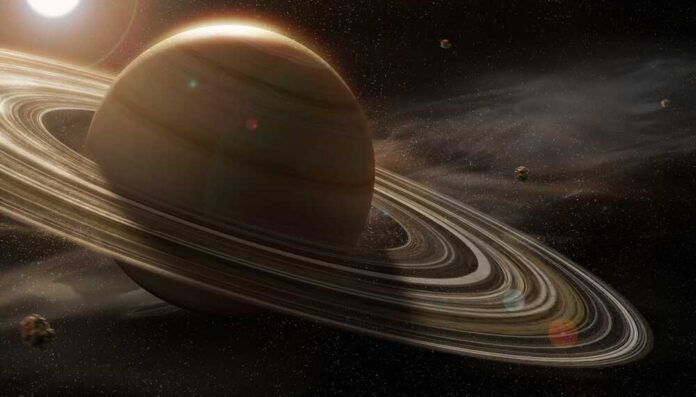
A tiny Saturn-like world hiding in a dusty ring around a baby star just gave James Webb its first real “found it by sight” planet – and a new way to watch solar systems being born.
Story Snapshot
- The James Webb Space Telescope directly imaged a faint Saturn-mass planet, TWA 7 b, orbiting a young, nearby star.
- The planet sat unseen for decades in a gap of the star’s debris disk, then popped out as a faint infrared dot.
- TWA 7 b is the lightest planet ever captured by direct imaging, only about one-third the mass of Jupiter.
- This first “found by picture” planet for Webb hints we can soon see smaller, colder worlds far from their stars.
A small hidden planet that rewrites how we see young solar systems
Astronomers spent years staring at the young star TWA 7 and saw only dust, rings, and hints that something might be shaping them. The star is a red dwarf about 111 light-years away, just six million years old, still wrapped in a debris disk of rock and ice left over from planet formation.
That dusty disk showed narrow gaps and under-dense regions, the kind of scars a planet often leaves as it plows through. What they did not see, until James Webb looked, was the planet itself.
After more than a decade of cosmic hide-and-seek, astronomers have discovered a faint planet that had been overshadowed by a bright star. https://t.co/BZAjz1rote pic.twitter.com/MeSqQMRULN
— WANE 15 (@wane15) July 15, 2026
The turning point came in June 2024, when the James Webb Space Telescope used its Mid-Infrared Instrument with a special coronagraph to block most of the star’s blinding light.
Once that glare was stripped away with careful image processing, a faint orange source appeared exactly in a gap in the disk – the suspected hiding spot.
That source, TWA 7 b, is a gas giant with a mass of around 0.3 times Jupiter’s, roughly Saturn’s mass, and an estimated temperature near 320 kelvin. It sits about 50 astronomical units from the star, orbiting far beyond the dusty inner rings where rocky planets might form.
James Webb’s first directly discovered planet and a record-breaking lightweight
This tiny world is more than just another exoplanet. It is the first planet discovered by the James Webb Space Telescope, found directly by imaging rather than following up on other telescopes’ hints.
Earlier Webb work confirmed planets seen by other missions, like LHS 475 b, using transit signatures. TWA 7 b flips that script: Webb did the hunting and the catching in one shot.
That matters because direct imaging of exoplanets is notoriously hard and has mostly snagged very massive, blazing-hot giants. TWA 7 b is about ten times less massive than any planet previously directly imaged, making it the lightest exoplanet ever photographed this way.
The planet is still called a candidate in the technical literature because exoplanet confirmation demands discipline. Scientists want follow-up checks to rule out tricksters like background galaxies or random faint stars that just happen to sit in the same line of sight.
That is why Webb’s team and others plan more imaging, spectroscopy, and motion tracking to watch this faint dot move with the star over time.
However, every public primary source – the European Space Agency, the French National Center for Scientific Research, and the Nature paper – points to the same basic conclusion: this is a Saturn-like planet shaping the disk around its young star.
From dusty scars to a living planet and what it means for alien worlds
The most important part of the story is how TWA 7 b links the planet we can see to the structure we already saw. The debris disk around TWA 7 is not smooth; it shows rings, gaps, and possibly a dust-rich region that could be a “Trojan” cloud trapped in the planet’s orbit, like the Trojan asteroids that share Jupiter’s path.
If further data confirm the dust feature, this system would offer the first observational hint of a Trojan disk associated with a planet outside our solar system.
Direct imaging discoveries like this take time, and many early candidates have turned out to be false alarms once more data arrived. That history is one reason some online videos now push a “they are hiding something” angle whenever a big space discovery has no public critics.
But here, the lack of a Side B is simple: no serious scientist has yet published a specific, sourced challenge to the data.
Healthy skepticism belongs in the lab, in re-analysis of raw Webb images and new simulations of how a Saturn-mass planet distorts a debris disk, not in clickbait that mixes this real detection with unrelated concerns about other stars.
How this faint dot changes the future of exoplanet hunting
NASA’s count of confirmed exoplanets has now passed six thousand, but almost all were found with indirect methods like the transit method, watching stars dim as planets pass in front of them.
Direct imaging has been the rare, “luxury” method reserved for huge, hot planets far from their stars, simply because smaller ones were too faint.
TWA 7 b shows that Webb’s mid-infrared eyes can break that barrier and see planets as light as one Saturn, maybe even down to a few tens of Earth masses in the right systems. That opens a fresh window onto the messy teenage years of solar systems, when dust, debris, and young planets fight for space.
For everyday readers, the takeaway is clear and practical. A ten-billion-dollar telescope finally did what many had hoped it would: it took a picture of a new, relatively small alien world and caught it in the act of shaping its home system.
That is not hype; it is careful science backed by peer review and multiple agencies in agreement. As more planets like TWA 7 b appear in Webb’s images, we will move from guessing how worlds form to watching that process unfold, one faint hidden planet at a time.
Sources:
abcnews.com, esawebb.org, sciencenews.org, x.com, phys.org, cnrs.fr, theguardian.com, sciencedaily.com, science.nasa.gov, earthsky.org, planetary.org, astrobites.org