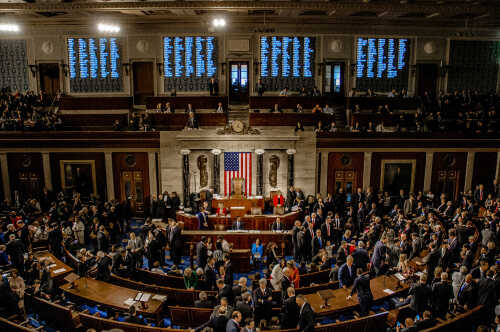
The House blocked a Republican push to lock the Supreme Court at nine justices, keeping the door open to future fights over the Court’s size.
Story Snapshot
- The proposed amendment would fix the Court at one chief justice and eight associates.
- Sponsors framed it as protection against future court expansion by Democrats.
- The plan advanced in committee but lacked the two-thirds support needed.
- Nine justices has been the norm since 1869, though the Constitution sets no number.
What The Amendment Tried To Do
House Republicans placed simple language on the table: the Supreme Court “shall be composed of nine justices consisting of one chief justice and eight associate justices”. The text aimed to replace statute with constitutional cement.
That move would prevent any future Congress from adding seats by simple legislation. Supporters said it would cool a cycle of partisan arms races and safeguard the Court’s standing with the public.
The measure had clear sponsors and momentum. Representative Dusty Johnson touted dozens of cosponsors, while Representative Andy Biggs filed similar language on day one of the session.
The House Judiciary Committee moved it forward on a party-line vote, signaling unified Republican will to get a floor test. But momentum is not math. A constitutional amendment requires two-thirds of the vote, and the votes were not there in either chamber.
Why Nine Became The Battleground
Proponents point to 1869, when Congress set the Court at nine justices, a structure that has held for over 150 years. They say stability matters more than short-term political gains.
They argue a fixed nine deters threats to “pack the Court” and helps preserve trust in rulings that shape daily life, from speech to property rights. This case aligns with changing the Constitution rarely, keeping institutions steady, and stopping power grabs before they start.
Opponents counter with history and design. The Constitution does not set a number, and Congress has changed the Court’s size several times in the early Republic.
Some Democrats cite a mismatch between 13 federal circuits and only nine justices to argue that growth could track the courts’ structure today. They also tie support for expansion to grievances over recent confirmation battles that hardened partisan lines on the bench.
House Democrats on Wednesday overwhelmingly voted against a constitutional amendment to set the number of Supreme Court justices at nine. https://t.co/Xx6Rm1Mlb8
— The Washington Times (@WashTimes) September 2, 2026
The Votes, The Gap, And The Stakes
Supporters advanced the amendment to block a potential future expansion that could undo a six-to-three conservative tilt on the Court. They saw the measure as a firewall against the use of raw numbers to reverse precedent outside the ballot box.
Critics saw a partisan shield dressed as a neutral reform. They argued the threat was not imminent and claimed Republicans wanted to freeze today’s balance instead of fix real selection and ethics issues.
Both sides cite legitimacy. Republicans claim stability builds it; Democrats say flexibility protects it when process norms break. The Congressional Research Service notes scholars broadly agree Congress may alter the Court’s size by law, even as many experts warn that expansion would deepen perceptions of partisanship. That tension explains the impasse: legal power exists, but prudence and politics restrain it.
What Comes Next If Nine Is Not Locked In
The failed amendment does not end the fight. Expect more messaging votes, more state-level resolutions, and fresh Senate pitches to keep the Court at nine through constitutional change.
Also expect hearings that showcase competing fixes, such as term limits or binding ethics rules, that do not affect the number of seats. Each path tests a core question: do we guard the Court by changing less, or by changing smarter?
NEW: House Democrats block GOP-led constitutional amendment to lock Supreme Court size at 9 justices
212-206, short of the 2/3rds majority.
Every Dem but Don Davis voted NO; leaders whipped NO.
As Dem support to expand SCOTUS grows.
w/ @KyleAlexStewart https://t.co/uyCYsW63Rf
— Sahil Kapur (@sahilkapur) September 2, 2026
A number in the Constitution ends the game of adding seats when power shifts. But rules need broad buy-in to last. Without supermajorities, this becomes a story of signaling rather than settling.
The history is plain: Congress can change the Court’s size, yet it has not in a century and a half. That habit, not a headline, still sets the odds for the next round.
Sources:
cbsnews.com, congress.gov, reuters.com, dustyjohnson.house.gov, ms.now, constitutioncenter.org, facebook.com