
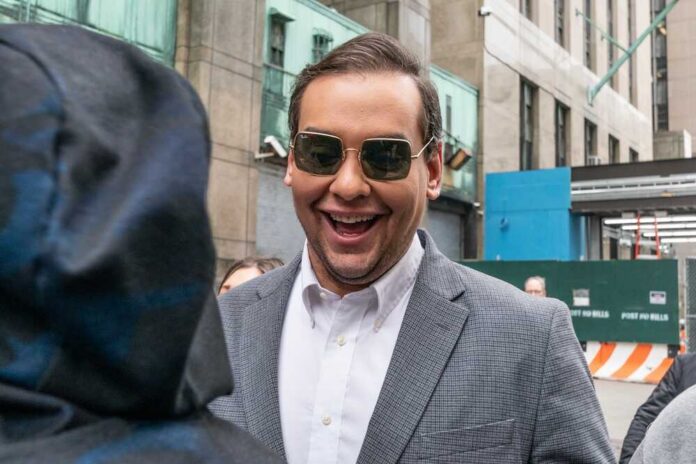
A former congressman is now accused of turning his own public persona into a get‑rich‑quick scheme on a prediction market, and the way it allegedly worked should make every voter sit up straight.
Story Snapshot
- Federal investigators are probing whether George Santos manipulated a prediction market by hyping an event he already bet against.
- The case tests whether insider trading concepts apply when the “inside information” is your own future behavior.
- Kalshi reportedly froze Santos’ account and referred the matter to federal regulators and the Department of Justice.
- The probe lands on top of an already sprawling fraud and identity theft indictment against Santos.
How a social media tease became a federal insider trading probe
Federal investigators at the Department of Justice and the Commodity Futures Trading Commission are examining whether former New York congressman George Santos used nonpublic information to profit from trades on Kalshi, a regulated prediction market that lets users bet on political and economic events.[1]
The focus is a contract on whether Santos would attend President Trump’s State of the Union address after his release from federal prison.[1] The allegation is simple: he knew the answer before the public did and allegedly wagered accordingly.
DOJ probing George Santos over insider trading after ex-rep's alleged Kalshi bets on his own appearance at Trump address: report https://t.co/dr6OttwPcP pic.twitter.com/rcZKVzsko6
— New York Post (@nypost) June 2, 2026
In February, Santos told his followers on social media that he was excited to attend the State of the Union, a post that reportedly sent the market odds of his attendance sharply higher.[1]
As the odds rose, someone using a Kalshi account attributed to Santos by three people familiar with the trades allegedly placed large bets that he would not attend.[1] When he later announced he was “stuck at the airport” and did not show up, the market price crashed, and the account is said to have made tens of thousands of dollars in profit.[1]
Why prediction markets are suddenly in Washington’s crosshairs
Prediction markets like Kalshi exist on the idea that thousands of people betting on outcomes will collectively produce an accurate forecast, a sort of crowd-sourced odds machine.[1] Their defenders claim that this improves public understanding of risk in elections, policy fights, and economic events.
Their critics see a casino built on politics that tempts mischief: if a single person can move the odds with a tweet, then the line between information and manipulation becomes dangerously thin.
In the Santos case, regulators are reportedly asking whether a politician’s own unannounced plans count as “material nonpublic information” when that politician can move both the market and the outcome.[1]
Traditional insider trading law developed around executives trading on secret corporate earnings, not elected officials betting on whether they themselves will walk into a chamber. Yet the basic concern overlaps: when someone controls an event and quietly profits from the public being wrong about it, trust in both markets and institutions takes a hit.
Kalshi’s self‑policing and what it signals about the platform
Kalshi did not wait for a subpoena to sound the alarm, according to reporting on its internal investigation.[1] The company allegedly spotted the suspicious trades, froze the account tied to Santos, and referred the matter to both the Commodity Futures Trading Commission and the Department of Justice.[1]
That decision undercuts the narrative that prediction markets are lawless zones and instead suggests that at least one platform understands its survival depends on showing regulators it can police bad behavior.
A functioning market requires both liberty to trade and confidence that the game is not rigged by insiders. When a platform self-detects, shuts down, and reports a high-profile user, it strengthens the argument that prediction markets can coexist with common-sense rules.
If anything, the alleged scheme highlights why clear enforcement against manipulation is essential, not why the entire concept of political event markets must be shut down.
Santos’ denial, his broader legal troubles, and what patterns matter
Asked about the Kalshi probe, Santos reportedly responded, “Well, that’s news to me,” and has denied wrongdoing.[1] Public reporting does not yet include his detailed explanation for the timing of the social media posts, the alleged trades, or any release of his account records.
The lack of a documented alternative chronology does not prove guilt, but it leaves the public evaluating circumstantial evidence and character, a tough position for someone already indicted on multiple fraud-related counts.[1][2]
The George Santos Kalshi probe isn't a reason to fear prediction markets. It's proof they grew up.
Insider trading rules exist because the markets matter now. Nobody investigates a game nobody takes seriously. Regulation is the cost of being real.— Spencer Gareiss (@SGareiss) June 3, 2026
Separate from Kalshi, federal prosecutors have charged Santos with a 23-count indictment that includes conspiracy, wire fraud, false statements, falsification of records, aggravated identity theft, and credit card fraud.[2]
Prosecutors allege he stole donors’ identities and used their credit cards without authorization to funnel money into his campaign and personal accounts, while lying to the Federal Election Commission about fake loans and contributions.[2]
For many Americans who prize personal responsibility and honesty with donors and taxpayers, that existing record weighs heavily when judging new allegations.
What this means for ordinary voters and common-sense rules
Washington scandals often feel remote, but this one points straight at your pocketbook and your trust. If politicians can gamble on their own public appearances, what stops them from wagering on legislative outcomes they secretly plan to tank or delay?
Prediction markets can deliver useful information, but only if participants believe no one is quietly monetizing their inside track or their ability to mislead the crowd. Rules against insider advantage exist to protect the little guy who does not drink in the back room with the power brokers.
If the investigation confirms that Santos publicly teased an appearance he had already bet against, then a strong enforcement response would not be “anti-market”; it would be pro-honesty and pro-accountability.
If, on the other hand, the facts ultimately clear him, that outcome would still set an important precedent for what counts as legitimate political betting. Either way, the case forces a timely question: when someone in power starts treating public trust like a side hustle, how quickly should the market — and the law — shut it down?
Sources:
[1] Web – George Santos faces federal probe into insider trading on Kalshi
[2] Web – Trump’s DOJ probing disgraced ex-GOP congressman for insider …