

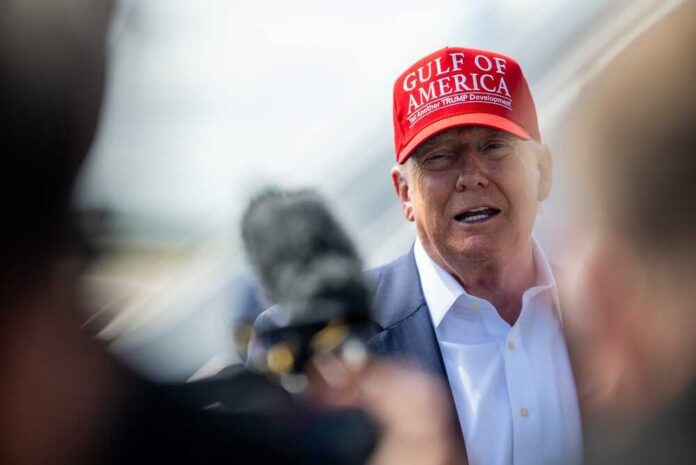
“I don’t want Canadian anything” was not a quip; it was marching orders tied to tariffs, factories, and a deliberate push to pull production over the border.
Story Snapshot
- Trump urged Canadian companies serving U.S. buyers to move their production to America now.
- The White House tied the pressure to Section 232 steel and aluminum tariffs and possible 50% levies on cars and parts.
- Canada promised dollar-for-dollar retaliation and announced targeted countermeasures.
- Reports say tariff relief is available to firms that commit to shift operations to the United States.
What Trump Said And What It Targets
President Trump escalated his public case against Canada by calling the neighbor a long-time trade abuser and urging Canadian companies to “move to the United States, immediately.”
He framed the message with a blunt line: “I don’t want Canadian cars, I don’t want Canadian parts, I don’t want Canadian anything.”
News reports highlighted the looming threat of 50% tariffs on Canadian autos, parts, and metals, moving beyond rhetoric to a direct warning aimed at supply chains. The White House amplified the theme in an August release.
The targeting is not random. The administration rebuilt the legal basis in 2025, restoring a 25% tariff on steel and raising the tariff on aluminum to 25% under Section 232 of the Trade Expansion Act of 1962, citing national security authority. That framework is proven in U.S.-Canada spats.
In 2020, the United States reimposed a Section 232 duty on certain Canadian aluminum after an import surge, then later reversed course as conditions changed. The current fight reprises that pattern but with a broader scope that includes autos.
How The Strategy Pressures Companies
Leveraging pain points is the point. Canada’s economy is heavily export-oriented, so any tariff shock on cars, trucks, parts, steel, and aluminum squeezes margins right away. Canadian leaders vowed to match U.S. tariffs dollar-for-dollar, rate-for-rate, which confirms the standoff is real, not just loud talk.
A key twist raises the stakes: reporting says Washington offered immediate tariff relief to Canadian and Mexican metal firms that agree to invest in moving production to the United States later. That is a carrot beside a very large stick.
Policy veterans have seen this movie. Section 232 acts like a pressure valve and a magnet. First, tariffs hit. Next, retaliation lands. Then, exemptions, relief deals, and relocations appear as exits. The administration clearly wants the last step to dominate.
If a Canadian smelter or parts maker must choose between long-term tariffs or a U.S. plant with relief, the White House expects the map pins to shift south.
What Canada And Critics Argue
Canada’s government rejects the U.S. case. Officials call the tariffs unjustified and promise to defend workers and industries harmed by them. A fact-check cited that Canada’s vehicle tariff moves mirrored U.S. steps, arguing Ottawa reacted rather than led the escalation.
Business press and analysts warn about the real costs for both sides, and some coverage highlights that heavy duties could shock Canadian firms and their employees, forcing hard choices between relocation and price hikes. These reactions show the policy is biting, which is also the point of pressure.
Economic pushback cuts two ways. Critics point to findings showing that U.S. businesses and consumers bear most of the tariff costs, challenging the idea that “foreign countries pay” and underscoring that downstream American buyers feel it too. That argument aims to blunt public support by tying tariffs to grocery, car, and packaging prices.
Even so, the administration counters that short-term pain can protect critical industries, rebuild capacity, and reduce reliance on foreign inputs that may be politically fragile or strategically risky.
The Stakes For Metals And Autos
Steel, aluminum, and autos are not just line items. They shape wages, towns, and defense sourcing. The United States revived core metal tariffs at 25%, hardened the legal posture, and floated auto duties as high as 50% on Canadian-origin vehicles and parts. This is leverage designed to move factories and tooling, not merely to collect tariff revenue.
Canadian retaliation can sting farm states and manufacturers, but past joint statements show both countries have stepped back when the pain outweighed the gain. That history suggests a negotiated off-ramp is possible once ground shifts.
Trump versus Canada on China.
Who is tougher when it comes to protecting us from Chinese steel and aluminum dumping and creating jobs at home?
Canada
Canada taxes Chinese steel and aluminum at 25%, tracks Chinese metal even when routed through third countries, severely…
— Glen Murray (@Glen4Climate) August 31, 2026
The open question is speed. If even a slice of Canadian suppliers chooses U.S. expansion to secure market access, the White House can claim a win on jobs and security. If most firms wait for a truce, costs could mount for consumers and producers across North America.
Sources:
en.yenisafak.com, economictimes.com, ustr.gov, theguardian.com, nytimes.com, cbc.ca, nbcnews.com, bbc.com, whitehouse.gov