
A veteran economist with 36 years of professional forecasting just said the stock market has never been more disconnected from the real economy in his entire career — and the numbers backing that claim are hard to dismiss.
Quick Take
- Moody’s Analytics chief economist Mark Zandi puts U.S. recession odds at 40%, nearly triple the historical baseline of 15%
- Real job growth has nearly stalled, real disposable income sits flat year-over-year, and real consumer spending has gone nowhere in 2026
- Zandi says the stock market rally is driven by a narrow cluster of artificial intelligence-focused companies, masking broad economic fragility beneath the surface
- Tariffs, immigration policy tightening, and the Iran conflict are the policy triggers Zandi says could push the economy over the edge
A 40% Recession Probability Is Not a Rounding Error
Mark Zandi, chief economist at Moody’s Analytics, did not hedge when he put a number on where things stand. “40% is very elevated, very uncomfortable — it gives you a sense of how close I think things are to the edge here,” he said in a recent interview. [1]
The historical average recession probability in his model sits around 15%. Nearly tripling that baseline is not a minor technical adjustment. It is a serious signal from someone who has spent nearly four decades building and interpreting these models for a living.
The labor market is where Zandi’s concern gets most specific. Real job growth has “nearly stopped,” by his assessment, and he expects negative payroll months soon. [5]
Historically, negative payroll prints are not a warning sign of recession — they are the opening chapter of one. He also pointed to a sharp deceleration in foreign-born labor-force growth, which had been running at 4 to 5% annually and has now turned negative, flattening the overall labor force since the start of the year. [5] When the workforce itself stops growing, the math on economic expansion gets very difficult very fast.
Top economist sounds alarm on America’s 40% recession risk, warns stocks are disconnected from reality https://t.co/57286XAjZr
— FOX Business (@FoxBusiness) May 20, 2026
The Consumer Is Running on Fumes
Two of the most reliable recession predictors are real disposable income and real consumer spending. Both have stalled. Zandi stated plainly that real disposable income — after taxes and after inflation — is no higher today than it was a year ago. [1] Real consumer spending has been flat throughout 2026, with lower- and middle-income households bearing the most visible stress. [5]
These are not abstract model variables. They represent the purchasing power of actual Americans, and right now that purchasing power is going nowhere.
What makes this particularly concerning is that headline unemployment numbers can look deceptively stable even as the underlying labor market softens. Participation rates, foreign-born workforce trends, and hours worked tell a different story than the top-line unemployment figure.
Zandi’s argument is that the surface looks calm precisely because deterioration is occurring beneath the indicators that casual observers watch most closely.
The Stock Market Is Not the Economy — But It Thinks It Is
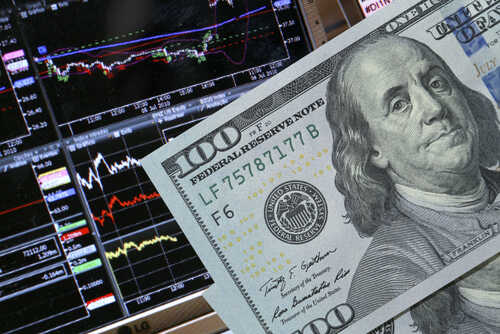
Zandi’s sharpest line may be his observation about equity markets. “In my 36 years as a professional economist, the stock market’s never been more disjointed from the economy,” he said. [1]
He attributed the disconnect to a narrow group of hyperscalers and chip companies driving index-level gains, while the broader economy softens.
That concentration risk is real. When a handful of artificial intelligence-adjacent companies account for a disproportionate share of market capitalization, the index ceases to function as a reliable economic barometer.
Stocks are pricing perfection while the economy looks shaky. Mark Zandi says markets are increasingly disconnected from fundamentals, AI hype is doing heavy lifting, and recession odds stay at 40% over the next 12 months. Risk is the story. #stocks #economy pic.twitter.com/kIPFURdDnz
— geekopedia (@geekopediax) May 20, 2026
This is not the first time markets have decoupled from economic reality with such enthusiasm. The late 1990s technology rally had similar characteristics — concentrated in a narrow sector, justified by transformational narratives, and ultimately disconnected from earnings fundamentals.
Zandi stopped short of calling the current moment a bubble, but his comparison to the dot-com era carries weight. The burden of proof falls on those arguing that this time is structurally different, not on those raising the valuation question. [4]
Policy Is the Difference Between a Soft Landing and a Hard One
Zandi has been explicit that recession is not inevitable. He said the U.S. can still avoid it if policymakers “get out of their own way.” [4] That means unwinding broad-based tariffs, pulling back from heavy-handed immigration enforcement that is shrinking the labor force, and avoiding further foreign-policy escalation in the Middle East.
He also provided a concrete oil-price threshold: if crude averages near $125 per barrel in the second quarter, the economic stress becomes material — and he described that scenario as “not a stretch” given current geopolitical conditions. [3]
That conditional framing is worth taking seriously rather than dismissing. Zandi is not predicting inevitable collapse. He is describing a probability distribution where bad policy choices convert a fragile economy into a contracting one.
From a standpoint, the irony is pointed: government-driven policy distortions — tariff regimes, labor-force restrictions, energy-market disruptions — are the variables most likely to tip the scale. Markets can absorb a lot of uncertainty. They are far less forgiving when uncertainty is manufactured by the same institutions claiming to manage it.
Sources:
[1] Web – Mark Zandi puts U.S. recession odds at 40%, warns economy is ‘on …
[3] Web – Moody’s Mark Zandi: Risk of recession was increases prior to war in …
[4] Web – Recession Risk Is ‘Rising Significantly,’ but US Can Still Avoid It
[5] YouTube – Why Mark Zandi Says the Economy Is “Fragile”