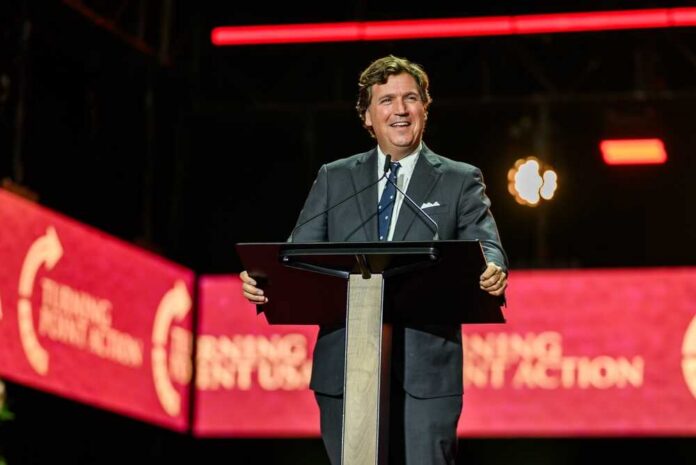
Poland’s embassy publicly demanded Tucker Carlson retract and apologize for “falsifying” World War II history, and they named him an apologist for Adolf Hitler.
Story Snapshot
- Poland’s envoy in Washington issued a written demand for a retraction and apology.
- The embassy said Carlson denied Nazi aggression and insulted victims of Nazism.
- Reports quoted Carlson saying Hitler’s invasion of Poland was not unprovoked.
- The clash spotlights how media battles warp public memory of World War II.
Poland’s Embassy Draws a Bright Red Line
Poland’s chargé d’affaires in Washington, Bogdan Klich, sent a formal letter to Tucker Carlson demanding an immediate, public retraction and apology for his recent World War II remarks. The letter, posted by the Polish embassy, accused Carlson of “completely falsifying the documented historical record” and of becoming “an apologist for Adolf Hitler.” The envoy framed the statements as a grave insult to victims of Nazism and a denial of clear Nazi aggression against Poland in 1939.
The embassy’s language was direct and severe. It charged that Carlson crossed from debate into distortion that whitewashes the opening crime of the war. By using diplomatic channels and public posting, Poland ensured the rebuke would register beyond media cycles. That posture also signaled a defense of national memory, not just political pride. The message was simple: Poland will not let a popular host reset the story of how the war began, at Poland’s expense.
What Carlson Said That Sparked the Fire
Coverage of Carlson’s exchange with British politician Jacob Rees-Mogg quoted Carlson saying “the idea that Hitler just randomly rolled into Poland is a lie.” He pointed to territory lost by Germany after World War I and said that was Hitler’s case “and by the way, that was true.” Reports also quoted him saying the United Kingdom had “nothing to do with” the war over Poland, minimizing Britain’s pledge to defend Poland against invasion.
Reporters and commentators tied these remarks to a wider claim that Britain erred by fighting Germany over Poland, and that Hitler had a factual basis for his move. To many, that framing echoed prewar propaganda and blurred the clear line between grievance and aggression. Poland treated the remarks not as a niche history debate but as public justification for an unprovoked attack that killed civilians and shredded a sovereign state’s borders.
The Historical Frame and Why It Matters
The fight is not over arcane details. It is about whether grievances after World War I excuse the invasion of a neighbor. Many nations hold grievances. Civilized nations resolve them without tanks at dawn. Poland’s response rests on that basic order. The 1939 attack split Poland with the Soviet Union, unleashed terror, and triggered Britain’s treaty response. Arguing that Hitler “had a point” risks turning cause and effect upside down for a mass audience that trusts concise takes.
Media storms like this follow a pattern. A high-profile figure offers a sweeping claim. Outrage erupts. The debate shifts from documents to vibes. Viewers pick teams. Memory bends around identity, not facts. Poland’s embassy tried to anchor the issue in evidence and dignity for victims. That approach tracks with how democratic governments push back on speech they deem harmful without suing, by using public censure and clear moral lines.
How The Claims Track Against Conservative Common Sense
Conservative instincts guard two pillars: national sovereignty and moral clarity about evil. Sovereignty means borders are not up for grabs by force, no matter the grievance. Moral clarity means Nazi aggression stays labeled as such. Carlson’s critics argue his framing muddied both. They say it downplayed a treaty promise to defend an ally and suggested that lost land transforms blitzkrieg into a case in equity. That logic fails any plain-reading test most conservatives would apply.
POLAND DEMANDS TUCKER CARLSON APOLOGIZE OVER WWII REMARKS
Poland’s Chargé d’Affaires in Washington, @BogdanKlich, has called on @TuckerCarlson to publicly retract and apologize for remarks made in his conversation with Sir Jacob Rees-Mogg about the outbreak of World War II.… pic.twitter.com/8h5mOzDzTt
— Mossad Commentary (@MOSSADil) October 6, 2026
Carlson’s defenders might answer that describing Hitler’s argument does not endorse it. That narrow defense is fair to test. But the reported quotes went further by calling the standard account “a lie” and by saying, “by the way, that was true.” That crosses from context into validation. Poland heard it that way. So did multiple outlets that framed the pushback as a defense of historical truth and of the dignity of those who died in the first onslaught of the war.
What To Watch Next
Three things will decide where this goes. First, whether Carlson releases a full transcript or clip that clarifies his meaning or tone. Second, whether he engages the core charge head-on or pivots to a “free speech” fight. Third, whether other allied governments or major institutions echo Poland’s stance. If more join in, the narrative will harden against the remarks. If not, the dispute may settle into the usual culture-war trenches and fade until the next flare-up.
Sources:
polskieradio.pl, tvpworld.com, poland-24.com, wiadomosci.onet.pl, unherd.com