
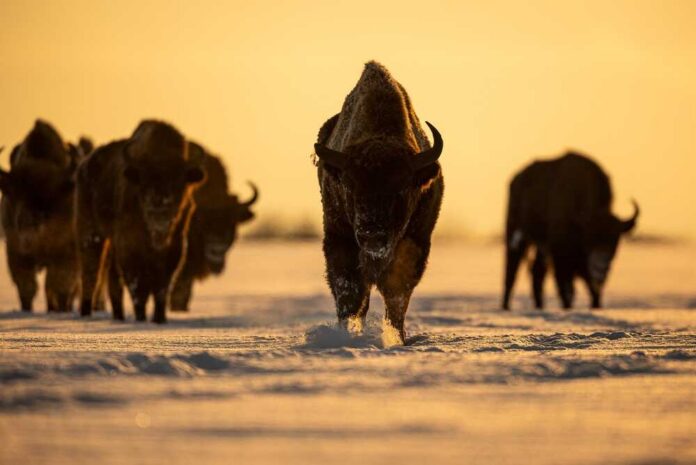
Most people fear bears at Yellowstone, but the animal that has sent more visitors to the hospital than any other since 1980 is one that looks slow, docile, and almost friendly — until it isn’t.
Story Snapshot
- A 12-year-old was injured by a bison at Yellowstone on June 26, 2026, near Mud Volcano, and was taken to a local hospital.
- Bison have injured more visitors at Yellowstone than any other animal since 1980 — more than bears, wolves, or any predator in the park.
- Park rules require visitors to stay at least 25 yards away from bison at all times. A Centers for Disease Control and Prevention study found every recorded bison injury happened because someone got too close.
- This is the first reported bison injury in Yellowstone in 2026, but it follows two separate goring incidents in 2025, as well as others in 2024 and 2023.
What Happened at Mud Volcano on June 26
At around 9:15 a.m. on June 26, a 12-year-old visitor was injured by a bison near Mud Volcano, just north of Fishing Bridge in Yellowstone National Park. Emergency medical workers took the child to a nearby hospital.
The park’s official news release confirmed the incident but did not describe the child’s injuries or explain exactly how the encounter happened. The investigation is ongoing, and no further details have been released. [6]
12-year-old hospitalized after being injured by bison in Yellowstone National Park https://t.co/CLJoovR849 pic.twitter.com/IpuzbVvlQ7
— New York Post (@nypost) June 28, 2026
The park has not said whether the child was alone, with a group, or how close they were to the bison. That silence has left a factual gap. But the absence of detail does not change what the data shows about how these incidents almost always unfold. The pattern is consistent and well-documented — and it points squarely at visitor behavior, not park failure.
Bison Are the Most Dangerous Animal in the Park — Not Bears
Most visitors walk into Yellowstone worried about grizzly bears. That worry is misplaced. Since 1980, bison have injured more pedestrian visitors than any other animal in the park. [15]
A peer-reviewed study published in the Centers for Disease Control and Prevention’s Morbidity and Mortality Weekly Report found that every single bison injury on record happened because the visitor failed to stay 75 feet away — the required distance at the time of the study. [15]
Three of those injuries happened while people were taking photos within 3 to 6 feet of the animal. One person was taking a selfie.
The Rules Are Clear, the Warnings Are Everywhere
Yellowstone hands out safety flyers at every entrance. Signs are posted in campgrounds, visitor centers, and along roadsides throughout the park. The rule is simple: stay at least 25 yards away from bison, elk, deer, moose, and coyotes, and at least 100 yards from bears and wolves. [13]
If a bison moves toward you, you move away. The park does not ask visitors to guess. It tells them exactly what to do, in plain language, before they ever leave the parking lot.
Yellowstone’s own statement after this incident repeated the warning it has issued after every similar event: “Bison have injured more people in Yellowstone than any other animal.
They are unpredictable, can run three times faster than humans, and will defend their space when threatened.” [6] A bison weighs up to 2,000 pounds. It does not bluff. When it charges, there is no outrunning it.
This Is Not a Freak Event — It Is a Recurring Pattern
In May 2025, a 47-year-old man from Cape Coral, Florida, was gored after he got too close to a bison near Lake Village. [19] In June 2025, a second person was gored near Old Faithful after a group of visitors crowded around the animal. Two more people were injured in 2024, and one in 2023. [14]
After a spike of 33 bison injuries between 1983 and 1985, the park ran education campaigns that cut the average down to fewer than one injury per year from 2010 to 2014. [16] The injuries came back when people stopped paying attention to the rules.
‼️ BISON INJURY: A 12-year-old was hospitalized after being injured by a bison on Friday morning while visiting Yellowstone National Park. This is the first reported bison attack in Yellowstone this year.
Read more: https://t.co/gV7bIICZGQ pic.twitter.com/OEoNg3N7F6— FOX Weather (@foxweather) June 27, 2026
The honest read of the evidence is this: Yellowstone has done its job. The rules exist. The signs are posted. The warnings are handed to every visitor at the gate. When injuries happen anyway, the cause is almost never a mystery. People get close because the animals look calm. Bison are not calm.
They are wild animals defending their space, and a 12-year-old paid the price for a lesson that should have been learned long before anyone stepped out of the car.
What Parents and Visitors Need to Know Before They Go
Twenty-five yards is longer than most people think. It is roughly the length of two school buses parked end to end. If you can see the bison’s eyes clearly without a zoom lens, you are too close.
If the animal turns toward you, do not freeze and do not run — back away steadily and give it room. Keep children close and within arm’s reach in any area where wildlife may be present. The park is not a zoo. The animals are not behind glass. The rules are there for a reason, and the reason is standing right in front of you.
Sources:
[6] Web – A child visiting Yellowstone National Park in Wyoming was injured …
[13] Web – Bison injures 12-year-old visitor at Yellowstone – KBOI
[14] Web – Yellowstone visitor injured by bison encounter – National Park Service
[15] Web – Yellowstone National Park bison attack leaves 12-year-old …
[16] Web – NPS Incident Reports – Yellowstone National Park
[19] Web – Notes From the Field: Injuries Associated With Bison Encounters