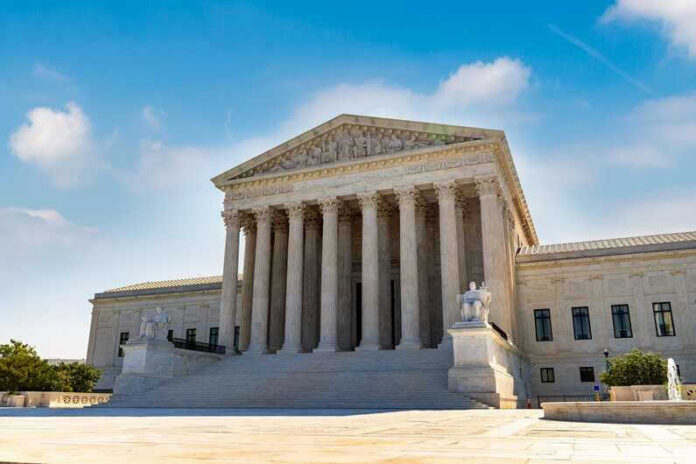
Millions of Virginians thought they had just redesigned their political map, only to watch two Supreme Courts quietly crumple it up and toss it in the trash.
Story Snapshot
- Virginia voters approved a constitutional amendment meant to create a new congressional map favoring Democrats.
- The Virginia Supreme Court struck the amendment down on procedural grounds, calling the referendum fatally flawed.
- The United States Supreme Court refused to step in, leaving the old district lines in place for the next elections.
- The clash highlights a hard lesson: in election law, process can outweigh both passion and majority rule.
How Virginia’s “People’s Map” Died In Two Courtrooms
Virginia’s political leaders sold the new map as democracy in its purest form: let the people decide their districts. More than three million Virginians cast ballots on a constitutional amendment to authorize fresh House lines, and a majority said yes, clearing the way for a voter-approved map projected to flip up to four Republican-held seats to Democrats in a narrowly divided United States House of Representatives.[1][2][3] For Democrats, this was not just redistricting; it was revenge for Republican gains in Texas, Florida, and elsewhere.[3]
BREAKING: The Supreme Court rejects Virginia's bid to restore a congressional map favoring Democrats. https://t.co/WrcexMohCv
— The Associated Press (@AP) May 15, 2026
That victory lasted just days. The Supreme Court of Virginia, in a 4–3 decision, declared that the Democratic-controlled General Assembly had not followed the Virginia Constitution’s required process for putting the amendment on the ballot.[2][3][4]
Lawmakers, the court concluded, moved the measure forward after early voting had already begun in the general election, violating a timing rule designed to prevent last-minute manipulation of what voters see on the ballot.[3][4] The court’s ruling did not parse partisan fairness; it attacked the procedure itself.
Why The State Court Said Voter Approval Was Not Enough
The Virginia Supreme Court did not merely wag its finger and warn the legislature to do better next time. Reporting on the opinion describes the justices saying the defect “irreparably undermines the integrity of the resulting referendum vote” and renders the amendment “null and void.”[3][4] In plain English: once leaders broke the constitutional sequence, no number of “yes” votes could fix it. That strikes directly at Democrats’ rhetoric that millions of voters had spoken and must be obeyed.[1]
State Democratic leaders fired back, accusing the court of overstepping and “nullifying the votes of millions of Virginians.”[1]
Attorney General Jay Jones, House Speaker Don Scott, and top Senate Democrats dashed to the United States Supreme Court with an emergency request, arguing that the state court mangled federal election law by treating early voting as part of the “general election” rather than as voting that simply occurs beforehand.[1] Their core claim: the timing rule was misread; the referendum was lawful; the people’s will should stand.
What The United States Supreme Court Really Signaled
The United States Supreme Court’s answer came in the most brutal format Washington offers: one sentence, unsigned, with no explanation and no noted dissent.[2][1] The justices declined to revive the map or block the Virginia ruling, which left the state court’s decision fully in control.[2]
For practical purposes, that meant Virginia would conduct its upcoming congressional elections using its existing lines, not the newly approved Democratic-leaning map.[2][3] For Democrats, four potential pickups vanished overnight.
Legally, that bare-bones order was not a full-blown endorsement of Virginia’s reasoning. Emergency relief is always a long shot, especially when the underlying question is state constitutional procedure rather than federal rights.[2] But optics matter. When every justice stays silent, opponents can plausibly say that even the nation’s highest court saw no federal problem with calling the map invalid. Supporters, by contrast, are left arguing technicalities about jurisdiction to explain away a loss that looks, to normal voters, like a slam of the door.
Process, Power, And A Cautionary Tale For Both Parties
This fight did not occur in a vacuum. The Virginia amendment was explicitly pitched as a response to Republican-tilted maps in Texas, Missouri, North Carolina, Ohio, and a fresh Florida plan.[3] National coverage already portrayed redistricting as a partisan arms race, where both sides stretch procedure to squeeze out a few extra seats.[2][3]
When Democrats in Richmond cut corners on timing, they handed their opponents an easy narrative: the party that screams about “democracy” ignored its own constitution until a court called foul.[3][4]
A written constitution is supposed to be a speed bump that slows down partisan passion. If a legislature can ignore procedure whenever it claims a big enough moral goal, then constitutional limits mean nothing. The Virginia Supreme Court, whatever one thinks of partisan maps, insisted that rules matter even when millions of voters later say they like the outcome.[2][3][4] That message aligns with basic common sense: first follow the law, then ask for votes.
Sources:
[1] Web – Supreme Court refuses to restore Virginia redistricting plan …
[2] Web – Supreme Court rejects Virginia Democrats’ bid to revive … – CBS News
[3] YouTube – Virginia Supreme Court strikes down gerrymandered redistricting plan
[4] Web – Supreme Court rejects bid to restore Virginia’s redistricting map …