

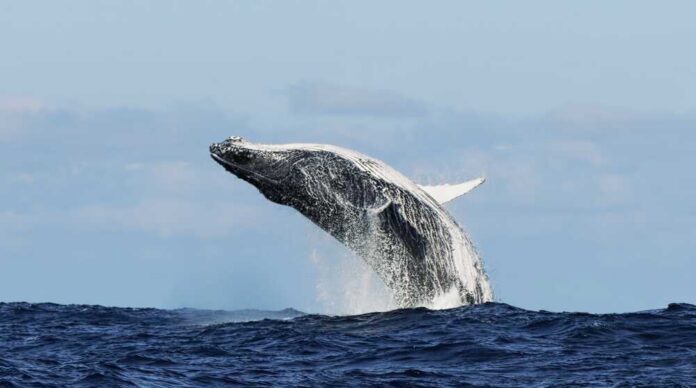
Rescuers abandon a massive humpback whale to its likely death in Germany’s Baltic Sea, embracing a hands-off approach that lets nature prevail over futile human meddling.
Story Snapshot
- A 12-15 meter humpback whale repeatedly strands in shallow Baltic waters, far from its Atlantic home, showing exhaustion and disease.
- Initial rescues with excavators free it temporarily, but it re-strands at Poel island inlet near Wismar.
- Experts led by Burkard Baschek declared no hope on April 1, 2026, shifting to passive monitoring amid weakening conditions.
- Rare Baltic appearance highlights migration risks in low-salinity waters unsuitable for long-term survival.
- Public fascination grips Germany through media and live streams, underscoring respect for natural limits.
Whale’s Repeated Strandings in Hostile Waters
A humpback whale measuring 12-15 meters first stranded in shallow waters at Timmendorfer Strand beach in Mecklenburg-Pomerania early last week, around March 24-27, 2026. Initial boat efforts to create waves failed.
Last Thursday, an excavator dug an escape channel, freeing the whale early Friday, March 27. The animal, disoriented in the brackish Baltic Sea, traveled eastward and stranded again Saturday, March 28, near Wismar Bay, as confirmed by Greenpeace.
This enclosed sea, with low salinity through the narrow Danish straits, offers no viable habitat for Atlantic humpbacks, leading to skin diseases and nutritional deficits.
Final Stranding and Rescuers’ Decision
The whale entered an inlet on Poel island near Wismar port on Tuesday, March 31, and stranded once more amid falling water levels. By Wednesday, April 1, 2026, drone footage revealed irregular breathing, minimal activity, and weakness.
Burkard Baschek, scientific director of Ocean Museum Germany and rescue coordinator, assessed that the 39-49 foot mammal showed little reaction to approaching boats.
A brief post-approach stir offered no real hope. Baschek announced at a televised press conference that the strategy of maximum rest and respect for nature now demands letting the whale go, as prior self-freedoms prove unrepeatable against tides and exhaustion.
A young humpback whale, named Timmy by rescuers, was struggling to find its way out of shallow bays off the Baltic coast of Germany after a week-long ordeal that has put its survival in doubt pic.twitter.com/rmrkcAPLwY
— Reuters (@Reuters) March 29, 2026
Expert Consensus on Fatal Outcome
Baschek stated rescuers firmly believe the animal will die in the inlet, citing its decline and environmental challenges. The Baltic’s low salinity stresses the whale, which is physiologically unfit, despite possible herring-chase or male-migration instincts drawing it hundreds of kilometers from the Atlantic.
The Mecklenburg-Pomerania Environment Ministry monitored post-release, while the local coast guard and fire department aided with earlier logistics.
No pro-intervention voices emerged post-Wednesday; consensus favors non-interference to avoid added stress. Theories attribute entry to disorientation, but survival prospects remain negligible without a return to the North Sea.
Broader Implications for Marine Wildlife
The ordeal captivates the German public with media alerts and live streams, disrupting local resorts yet fostering national focus. Short-term, exhaustion and disease signal imminent death; long-term, a potential necropsy could yield migration and health data amid climate-driven anomalies.
Rescue protocols evolve toward intervention limits, balancing welfare with reality. The emotional toll hits rescuers and observers alike, but the shift underscores common-sense limits to human overreach in nature’s domain. No political fallout noted, though it spotlights ecological boundaries in unnatural habitats.
Sources:
Rescuers lose hope for the humpback whale stranded in the Baltic Sea
Rescuers give up hope for humpback stranded in Baltic Sea
Rescuers lose hope for the humpback whale stranded in the Baltic Sea
Humpback whale freed by rescuers in Baltic Sea has become stranded again