

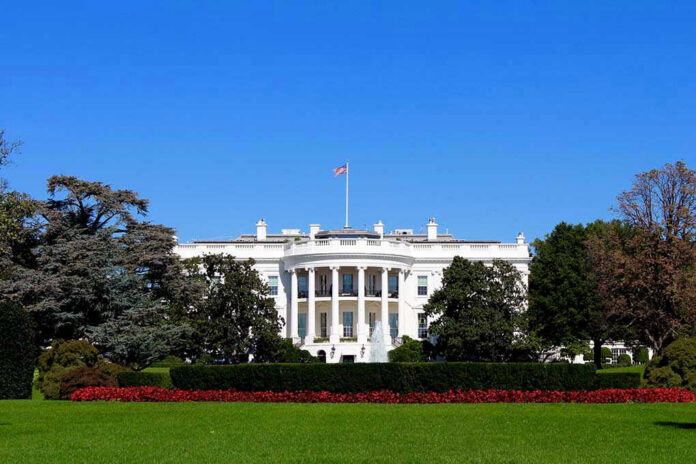
President Trump says a “massive” military complex is being built under a new White House ballroom—an explosive security revelation forced into the open by a courtroom fight over permits and oversight.
See the video below.
Quick Take
- Trump disclosed the underground project on March 30, 2026, during remarks to reporters aboard Air Force One.
- The planned $400 million, roughly 90,000-square-foot White House ballroom is designed to host large events and visiting dignitaries.
- Trump says the ballroom is privately financed and will include hardened protections such as bulletproof glass and “drone-proof” features.
- A historic-preservation lawsuit challenges whether required reviews and congressional authorization were bypassed; construction has continued as court decisions and regulatory votes approach.
Trump’s Disclosure Puts White House Security and Transparency on Collision Course
President Donald Trump told reporters on March 30, 2026, that the U.S. military is building a “massive complex” beneath a planned White House ballroom, describing the underground work as already underway and progressing well.
Trump framed the announcement as an unwanted consequence of litigation, saying a lawsuit effectively pushed sensitive details into public view. The administration has offered few specifics about the underground facility’s purpose or design, citing security.
BELOW THE SURFACE: President Trump reveals the U.S. military is building a "massive complex" beneath the planned, privately-funded White House ballroom, and that construction is "ahead of schedule." pic.twitter.com/VDbepFqox8
— Fox News (@FoxNews) March 30, 2026
Press Secretary Karoline Leavitt confirmed the military is making “upgrades” tied to the project but declined to provide additional details. That limited disclosure leaves the public with a narrow set of confirmed facts: the ballroom is planned, underground work is described as active, and the complex’s scope remains undisclosed.
Some outlets also reported uncertainty about independent verification of the underground build, underscoring how little has been formally documented for public consumption.
The Ballroom Plan: Size, Cost, and Hardened Features
The ballroom itself is a major physical expansion: reported as a 90,000-square-foot event space with an estimated cost of $400 million. Trump has argued that existing White House rooms are too small for large functions, pushing the case for a dedicated venue able to accommodate modern state events.
He also highlighted security-oriented features, including bulletproof glass and protections he described as “drone-proof,” signaling a design shaped by today’s threat environment.
Trump also said the ballroom is being financed privately—by him and donors—claiming “not one dime” of taxpayer money is going into the ballroom portion of the project. That claim is politically significant because it attempts to separate a high-dollar renovation from Washington’s long-running spending fights.
At the same time, the involvement of donors creates its own set of questions about transparency and process, especially while a legal challenge argues required steps were skipped.
Why Preservation Groups Went to Court—and What the Case Could Decide
The National Trust for Historic Preservation filed suit in December 2025 challenging the project’s legality, arguing the administration bypassed multiple required review processes and, according to reports, at least four laws. The group sought to pause construction until independent reviews, environmental assessments, and congressional authorization were addressed.
A federal judge rejected an initial request to halt construction, while later rulings on amended filings were expected around the end of March, keeping the project under legal pressure.
Regulators, Comment Volume, and the Next Approval Checkpoint
Even with construction activity reported, approvals and oversight have not disappeared. The U.S. Commission of Fine Arts approved the ballroom proposal in a unanimous 6–0 vote in February 2026, a step that fast-tracked design acceptance. Another key milestone is the National Capital Planning Commission vote scheduled for April 2026.
Reports say the commission received more than 32,000 written comments, suggesting the fight is not just legal—it is public and political too.
What’s Known, What’s Not, and Why It Matters for Constitutional-Minded Voters
The known facts paint a clear picture of a major renovation paired with undisclosed military infrastructure. The unknowns are just as important: the precise function, footprint, and capabilities of the underground complex have not been publicly described, and some reporting noted an inability to independently confirm construction details.
For constitutional-minded voters, the key test is process—whether executive-branch modernization and legitimate security needs were pursued with lawful review, proper authorization, and accountable decision-making.
Trump’s team argues presidents have broad authority to renovate and secure the White House, and the Department of Justice has argued in court filings that completing the ballroom is necessary for protection.
Preservation advocates counter that the method matters as much as the outcome, especially when demolition and new construction reshape a historic site tied to national identity. The next weeks will likely turn on court decisions and regulators’ votes—less on speculation about what’s underground than on what the law requires above ground.
Sources:
Trump says ‘massive’ military complex in the works beneath White House ballroom
Trump says ‘massive’ military complex to be built beneath White House ballroom
President Trump says military building complex under future White House ballroom: Construction
Trump claims donor-funded White House ballroom includes hidden build below; security focus