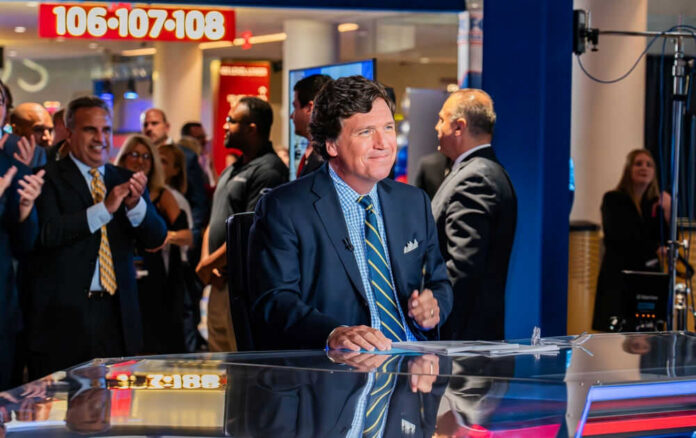
Tucker Carlson’s blistering rebuke of President Trump’s Easter threat toward Iran has exposed a real fault line inside the “America First” coalition—right as gas prices surge and a strike deadline looms.
Story Snapshot
- President Trump posted an expletive-filled Easter message on Truth Social, threatening strikes on Iranian infrastructure unless Iran “open[s] the … Strait,” including references to “Power Plant Day” and “Bridge Day.”
- Tucker Carlson condemned the post as “vile on every level,” arguing it promotes war-crime-style thinking and mocks Islam by invoking “Praise be to Allah.”
- Politico reported the episode is widening a rift between anti-interventionist conservatives and Iran hawks within the broader GOP coalition.
- Economic pressure is rising alongside the rhetoric, with reports of $4.14/gallon gas and spillover costs hitting consumers and shipping.
Trump’s Easter Iran Post Raises Stakes With a Deadline-Style Threat
President Donald Trump’s Easter weekend Truth Social post set off a new wave of controversy by pairing religious language with explicit threats against Iran’s civilian infrastructure.
The message demanded Iran “open the … Strait,” and warned of “Power Plant Day, and Bridge Day,” framed around a near-term deadline (“12:00 tomorrow night,” according to reporting). Politico also described an 8 p.m. deadline looming as the standoff intensified.
Tucker Carlson: "How dare you speak that way on Easter morning to the country? Who do you think you are? You're tweeting out the F word on Easter morning?" pic.twitter.com/NreE7YVAp3
— World Vibe (@world_vibe_en) April 6, 2026
The core policy question is bigger than the profanity: threatening power plants and bridges points directly at targets with heavy civilian spillover.
That matters legally, strategically, and morally, because modern wars are often judged less by who “wins” than by whether a campaign tries to minimize harm to noncombatants.
The research provided does not confirm whether strikes occurred; it only shows that the threat was public and time-bound.
Carlson’s Critique Focuses on War, Faith, and “America First” Credibility
Carlson’s response went beyond typical intramural conservative sniping. He described Trump’s post as “vile on every level,” arguing it endorses conduct that would be condemned if practiced by an adversary.
He also highlighted the “Praise be to Allah” phrase as religious mockery, saying no president should taunt Islam, particularly while issuing threats that could inflame a broader conflict with religious overtones.
Carlson’s argument lands on credibility: an “America First” brand is hard to sustain if the White House talks like it’s ready to bomb infrastructure on a countdown.
At the same time, hawks inside the coalition see maximal threats as leverage. The available research doesn’t quantify internal support, but it documents a widening split in public messaging.
Marjorie Taylor Greene’s Public Rebuke Signals the Rift Isn’t Just Media Drama
Politico reported that Marjorie Taylor Greene—once a reliable Trump ally—echoed the criticism and framed it in explicitly Christian terms.
Her message urged repentance and warned against “worshipping the President,” a striking admonition inside a movement that often prizes unity against Democrat obstruction.
Even without formal power, Greene’s role as a barometer for certain grassroots conservatives makes her reaction a meaningful indicator of discomfort.
Gas at $4.14 and Added Surcharges Put Foreign Policy Back at the Kitchen Table
The research ties the escalation to immediate economic pain: gas reportedly hit $4.14 per gallon, described as up 120% since the “war began,” alongside ripple effects such as airline fees and Amazon surcharges.
The sources summarized don’t provide a full methodology for those price claims, but the political dynamic is familiar—international confrontation quickly becomes domestic inflation, especially when shipping lanes and energy markets feel threatened.
That reality helps explain why this argument is happening now, in public, between factions that typically share domestic priorities.
Tucker Carlson issued a scathing critique of President Trump over comments he made over the weekend on the Iran war, particularly the president's vulgar social media post on Easter Sunday. https://t.co/xcWIaeQ9XJ
— ABC News (@ABC) April 7, 2026
The open question is what comes next: whether the rhetoric becomes action, whether Congress presses for oversight, and whether the White House recalibrates to avoid a broader war while still protecting U.S. interests.
With Republicans controlling both chambers, the main constraint may not be partisan resistance but internal agreement on first principles—deterrence versus restraint, and whether “America First” means projecting fear abroad or preserving stability at home.
Sources:
“No president should mock Islam”: Tucker Carlson blasts Trump’s Easter post threatening Iran
‘Vile on every level’: Tucker Carlson rips Donald Trump over Easter Iran Truth Social post