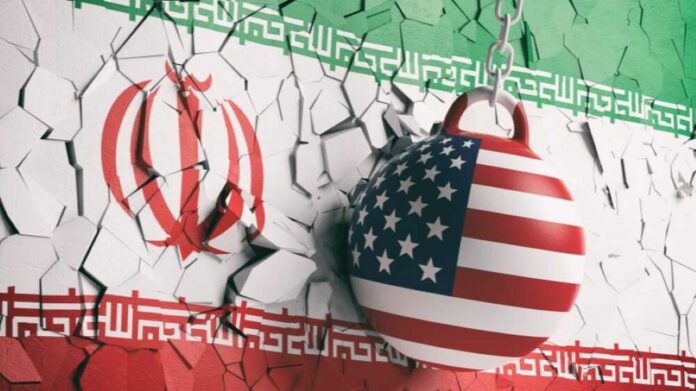
The real story behind the U.S. “self-defense” strikes inside Iran is not the explosions in the dark, but the silent legal and strategic line Washington claims it did not cross.
Story Snapshot
- U.S. Central Command says the strikes inside Iran were limited, lawful self-defense against imminent threats to American troops.[1][2][3]
- Targets reportedly included missile launch sites and Iranian boats suspected of laying naval mines near the Strait of Hormuz.[1][2][3]
- The action unfolded during a fragile ceasefire and active peace talks, raising fears of a wider escalation.[2][3]
- The public still has no hard proof of imminence; Americans are asked to take classified evidence on faith.[1][2][3]
How Washington Justified Bombs Falling During a Ceasefire
U.S. Central Command publicly framed these strikes as a textbook case of self-defense, not revenge.[1][2][3] Spokesman Captain Tim Hawkins said American forces hit targets in southern Iran “to protect our troops from threats posed by Iranian forces,” stressing that the military was “using restraint during the ongoing ceasefire.”[1][2] That combination—self-defense plus restraint—is no accident. It is the language lawyers choose when they want to signal that force stayed on the safe side of both U.S. law and international rules.
BREAKING: US military says it carried out ‘self-defense’ strikes in Iran
https://t.co/xCKasilZR9— FOX5 Las Vegas (@FOX5Vegas) May 26, 2026
Television reports and news tickers all highlighted the same point: these were not random targets deep in Iran, but specific military assets said to be part of an active threat cycle.[1][2][3] The list included missile launch sites and boats that U.S. officials said were trying to lay mines off Iran’s southern coast near Bandar Abbas, overlooking the Strait of Hormuz.[2][3] That strait is one of the world’s tightest energy choke points, so any hint of mines there triggers hard-nosed risk calculations, not just rhetorical outrage.
Missile Sites, Mine-Laying Boats, and the Imminence Question
Reports describe the boats as “attempting to place mines” or “allegedly preparing naval mines” near the Strait of Hormuz.[2][3] That wording matters. “Attempting” and “allegedly” tell you the press is repeating a government claim, not vouching for it as independently verified fact. The same holds for the missile launch sites: we are told they were targeted as part of a protective action, but the public record shows no released imagery, no intercepted radio traffic, and no third-party forensic analysis.[1][2][3]
The Defense Department insists the threats were serious enough to justify immediate action, yet neither transcripts nor video released so far establish the imminence standard that traditionally separates defensive fire from preventive or punitive strikes.[1][2][3]
There is no public casualty report, no account of an attack already under way against American forces. Citizens are essentially asked to take “self-defense” on faith, based on a classified intelligence picture they are not allowed to see.
Peace Talks, Ceasefire Optics, and the Escalation Tightrope
These strikes did not happen in a vacuum. They landed amid ongoing peace talks and what broadcasters repeatedly called a “fragile ceasefire” between the United States and Iran.[2][3] Commentators openly wondered how hitting targets on Iranian soil, however narrow the list, might affect a potential deal to end the conflict.[2][3] That tension is built in: negotiators want calm; commanders will not let their troops sit exposed while an adversary readies missiles or mines within range.
From a common-sense, security-first perspective, defending U.S. forces remains non-negotiable. No serious country allows hostile forces to quietly seed a key waterway with mines and point launchers at its people, then shrugs in the name of “optics.”
At the same time, when Washington invokes self-defense inside another sovereign state during a ceasefire, it should expect skeptics to demand a higher level of proof. Without transparent evidence, critics can easily frame the operation as escalation wrapped in legal language rather than a genuinely unavoidable response.
The Narrative War: Who Gets Believed First
In the first twenty-four hours, Iran had not offered a detailed public response, which left the American account largely uncontested in global media.[3] That vacuum let the label “self-defense strikes” harden into the default description across networks and headlines.[1][2][3] This dynamic is not new. In nearly every U.S.–Iran crisis around the Strait of Hormuz, the United States moves quickly with an official narrative tying its actions to force protection, while the evidentiary core stays locked behind classification.[1][2][3]
🇺🇸 The First Order Consequence: Renewed U. S. strikes in southern Iran heightened investor concerns about regional instability, lifting oil prices and dampening near-term expectations for a durable peace, reducing the likelihood that energy-market participants price in quick… https://t.co/KBlgShVlsB
— U.S.A.I. 🇺🇸 (@researchUSAI) May 26, 2026
That pattern carries both strategic value and political risk. Quick, confident messaging can deter further probing by an adversary and reassure allies that Washington will keep sea lanes open. Yet for citizens who remember past intelligence failures, from weapons of mass destruction in Iraq to misread signals in other conflicts, the phrase “trust us, the intel is solid” no longer settles the argument.
Responsible skepticism does not require reflexively doubting the military; it does demand real scrutiny when bombs fall during a declared ceasefire.[1][2][3]
Sources:
[1] YouTube – US Strikes Iran Missile Sites & Boats Amid Shaky Ceasefire …
[2] YouTube – US launches new strikes on Iran, targeting missile sites …
[3] YouTube – US Military Strikes Iranian Boats, Missile Launch Sites