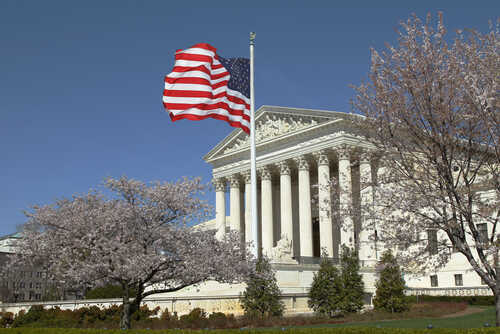
Louisiana’s challenge to the Voting Rights Act would dismantle minority voter protections, prompting national concern over minority representation.
Story Snapshot
- Louisiana challenges the constitutionality of Section 2 of the Voting Rights Act.
- Supreme Court to hear arguments today, potentially reshaping nationwide voting rights.
- State enacts new voting laws criticized for restricting access for vulnerable groups.
- Louisiana becomes a focal point in the fight over democracy and race.
Louisiana’s Legal Challenge to the VRA
In a bold move, Louisiana has positioned itself at the heart of the national debate on voting rights by challenging the constitutionality of Section 2 of the Voting Rights Act (VRA).
The state’s Republican leadership, led by Attorney General Liz Murrill, has filed a brief with the U.S. Supreme Court, arguing that Section 2, which mandates race-conscious redistricting to prevent racial discrimination, is unconstitutional.
This challenge highlights Louisiana’s role as a test case for the future of minority voting rights in America.
Simultaneously, Louisiana has enacted new voting laws that critics argue disproportionately limit access for vulnerable populations, such as people with disabilities.
These laws have been championed by Governor Jeff Landry and Secretary of State Nancy Landry under the guise of “election integrity.” However, civil rights advocates argue that these measures serve to disenfranchise minority and vulnerable voters, compounding the impact of the ongoing legal battle.
Supreme Court’s Critical Role
The U.S. Supreme Court is set to hear oral arguments on October 15, 2025, with a decision expected by June 2026. The implications of this case extend far beyond Louisiana, as the Court’s ruling could redefine the legal landscape of voting rights nationwide.
If the Court sides with Louisiana, it may weaken federal oversight and the creation of majority-minority districts, thus affecting minority representation across the country.
Louisiana’s aggressive stance is part of a broader trend among Republican-led states challenging federal voting protections. The outcome of this case could set a precedent for similar challenges, influencing the political dynamics in states with significant minority populations.
Potential Impacts and Reactions
A ruling in favor of Louisiana could result in the immediate invalidation of the state’s court-ordered majority-Black district and potentially lead to fewer majority-minority districts nationwide.
This would mark a significant setback for minority political representation, potentially reversing decades of progress in civil rights. Critics fear that such outcomes could elevate political and racial tensions, further polarizing the nation.
On the other hand, state officials argue that their challenge upholds constitutional principles and state sovereignty by rejecting federally mandated racial quotas.
The Supreme Court’s decision could redefine the balance between federal oversight and state autonomy in election laws, with long-lasting implications for American democracy.
Sources:
Louisiana at the Forefront of the Fight to Save the Voting Rights Act
Louisiana Governor Signs Multiple Anti-Voter Bills
Voting Rights Act: Louisiana Challenge
Louisiana Challenges Voting Rights Act at SCOTUS