

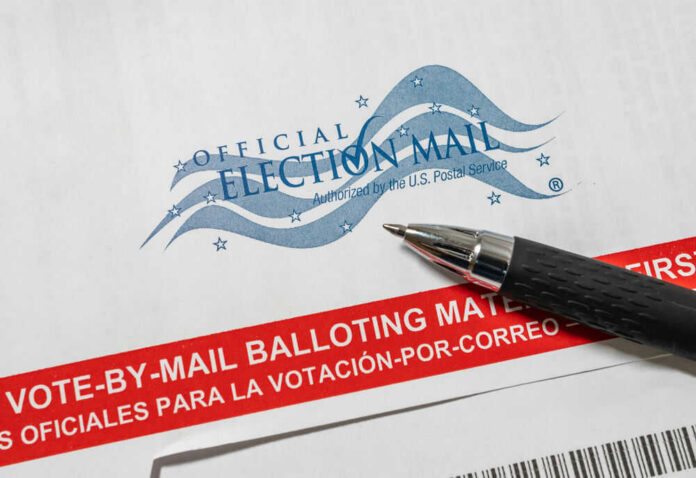
The Supreme Court just told America that Election Day is a deadline to vote, not a stopwatch on the mailbox—and that tiny twist could shape who gets heard in the next close race.
Story Snapshot
- The Supreme Court ruled 5–4 that states may count mailed ballots that arrive after Election Day if they were cast on time.
- The case, Watson v. Republican National Committee, rejected a Trump-backed effort to ban late-arriving ballots nationwide.[13]
- The majority said federal Election Day laws set when voters must make their choice, not when the mail truck must pull in.[13][17]
- The fight now shifts to state laws, fraud safeguards, and how much delay voters will tolerate before they stop trusting results.
The ruling that split conservatives and redefined Election Day
The case started in Mississippi, where state law allows election officials to count mail ballots postmarked by Election Day that arrive up to 5 business days later.
The Republican National Committee, joined by allies of former President Donald Trump, argued that federal law requires a single Election Day on which ballots must be both cast and received. Five justices disagreed.
Justice Amy Coney Barrett wrote that federal election statutes “do not set a deadline for ballot receipt,” so Mississippi’s grace period stands.[8][9][13][17]
Barrett drew a clean line: the law requires voters to make their choice by Election Day, not the Postal Service to deliver it by midnight. If the state says you must mail or drop your ballot by that Tuesday, you have met the federal rule, even if the envelope shows up on Thursday.
That logic pulled in Chief Justice John Roberts and three liberal justices, but it left Justice Samuel Alito warning that the Court had turned a firm date into “a span of multiple days” and invited fresh doubts about close races.[13][17]
Trump’s push for a hard stop and why the Court rejected it
Trump and his allies pressed a simple message: “Election Day means Election Day,” full stop. Their lawyers claimed that counting ballots received later creates “opportunities for fraud,” fuels suspicion, and, in close races, allows one party to eke out wins with late blue-leaning mail votes.
From this rule-of-law view, that has emotional force. People want clear lines. But neither the challengers nor anyone else put real evidence of widespread mail-ballot fraud on the table.[1][9][13][14][17][22]
BREAKING: Supreme Court allows states to count mail-in ballots that arrive late, rejecting RNC challenge. https://t.co/1IoL97uawo
— Breaking News (@BreakingNews) June 29, 2026
Decades of research on voting by mail find that documented fraud is rare and no more common in mail-voting states than others. A major study estimated about 11,000 Pennsylvanians in one cycle were deterred because their on-time mail ballots would have been rejected as late under strict receipt deadlines.
That means rigid “received by Tuesday” rules do not just block hypothetical fraud; they also throw out thousands of lawful votes over mail timing that voters do not control.[21][22]
Who wins, who loses, and what this means for election integrity
The people most helped by the ruling are not social media activists. They are military members abroad, missionaries, oil-field workers on rotation, and rural voters whose mail moves through a thin pipeline.
For them, a five-day buffer can be the margin between a counted ballot and a trash can. Barrett’s opinion echoed a basic fairness idea: a lawful ballot cast on time should be counted, even if the mail truck hits traffic.[2][7][17][21]
Supreme Court rules states can count late-arriving mailed ballots, rejecting Trump-led challenge https://t.co/pxq4zImx4c
— Chicago Breaking News (@ChicagoBreaking) June 30, 2026
Conservatives care deeply about election integrity, and they are right to demand tight voter rolls, secure handling of mailed ballots, and tough penalties for cheating.
When courts and researchers keep finding almost no proven cases of mail fraud, but tens of thousands of rejected ballots due to technical issues and late delivery, the bigger real-world threat to self-government is the wrongful loss of honest votes, not armies of fake ones.[20][21][22][24]
The next round: state battles, blue shifts, and voter trust
This ruling did not freeze policy in place. It shoved the fight back to the states. Since 2024, four Republican-run states have already moved to cut off all ballots that arrive after Election Day, even if mail delays are to blame.
Roughly 15 states and Washington, D.C., still count ballots that arrive later if they are postmarked by Election Day, but they now do so with a green light from the Supreme Court rather than a legal cloud hanging over them.[16][17]
That keeps the door open to “blue shift” drama, where same-day vote counts lean Republican, late-counted mail ballots lean Democratic, and social media fills the gap with conspiracy theories.
The smart conservative response is not to wage war on every late ballot, but to demand faster processing, better tracking, and real-time transparency. That means states start verifying mail ballots earlier, report how many remain, and explain clearly why totals change after Election Night.[18][24][25]
Why this matters beyond one Trump loss
Major outlets framed the ruling as a “big win for democracy” and a defeat for Trump. That spin will annoy many readers who see any loosening on deadlines as an invitation to mischief. Yet the Court did something more modest and more constitutional than the headlines admit.
It refused to turn a vague federal phrase about Election Day into a nationwide ban on state grace periods, and it declined to micromanage how every county handles its mail.[1][7][8][13][17]
From a federalist perspective, that restraint aligns with American tradition. States run elections. Washington writes the broad rules. Courts step in when there is real conflict, not simply because one side believes its preferred deadline is more “orderly.”
The burden now falls on governors, legislatures, and local officials to pair this ruling with tough safeguards, clean lists, and clear communication—so that when the next cliffhanger comes, Americans see late-counted ballots as the tail end of a fair process, not proof the game was rigged.
Sources:
[1] Web – Supreme Court rules states can count late-arriving mailed ballots, …
[2] Web – Supreme Court allows late-arriving mail-in ballots in defeat for Trump
[7] Web – The US Supreme Court ruled 5-4 Monday that states can count mail …
[8] YouTube – President Trump disagrees with Supreme Court ruling on mail-in …
[9] Web – Supreme Court rules states can count late-arriving mailed ballots …
[13] YouTube – Supreme Court upholds Mississippi mail-in ballot law
[14] Web – [PDF] 24-1260 Watson v. Republican National Committee (06/29/2026)
[16] Web – The Supreme Court on Monday upheld a Mississippi law that allows …
[17] Web – How many voters could be affected by earlier mail ballot deadlines …
[18] Web – Justices rule that states may count late-arriving election ballots
[20] YouTube – Potential legal challenges over late-arriving mail ballots
[21] Web – Election results, 2024: Analysis of rejected ballots – Ballotpedia
[22] Web – Measuring lost votes by mail – PMC – NIH
[24] Web – Millions of ballots are still being processed days after the primary …
[25] Web – Logical Election Policy