

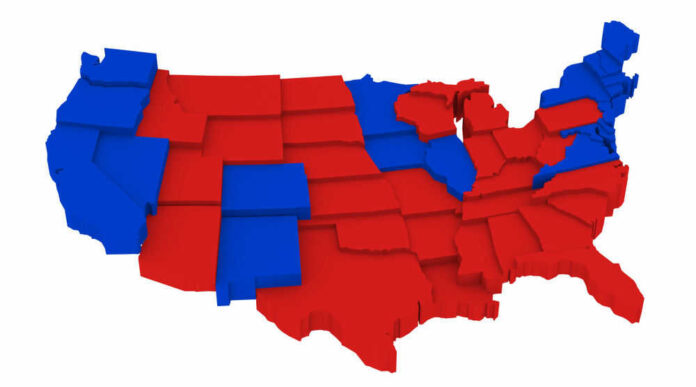
The Supreme Court delivered a massive victory for conservatives and President Trump by reviving Texas’s Republican-friendly congressional map that could flip five Democrat seats and secure GOP control of Congress through 2026.
Story Highlights
- Supreme Court overturns lower court ruling that blocked Texas’s pro-Republican redistricting map
- New map could flip five Democrat House seats to Republicans, strengthening Trump’s congressional majority
- Decision supports states’ rights to draw partisan electoral maps without federal court interference
- Liberal justices dissented, claiming racial discrimination while ignoring constitutional redistricting authority
Supreme Court Restores Constitutional Order
The U.S. Supreme Court struck down a lower court’s overreach that had blocked Texas from implementing its lawfully approved congressional map. The 6-3 conservative majority ruled that federal courts had “improperly inserted” themselves into state election processes, violating the delicate federal-state balance.
This decision reinforces constitutional principles that redistricting remains a state legislative function, not a federal judicial matter.
US SUPREME COURT REVIVES PRO-REPUBLICAN TEXAS VOTING MAP
(Reuters) – The U.S. Supreme Court revived on Thursday a redrawn Texas electoral map designed to add more Republicans to the U.S. House of Representatives, boosting President Donald Trump's quest for his party to keep… pic.twitter.com/FFvdIYwteP
— FXHedge (@Fxhedgers) December 5, 2025
Strategic Victory Secures Trump’s Legislative Agenda
The reinstated map positions Republicans to flip up to five currently Democrat-held House seats, potentially expanding the party’s narrow congressional majorities ahead of 2026 midterms.
With the GOPs currently holding a slim majority in both chambers, these additional seats would safeguard President Trump’s legislative priorities from Democrat obstruction. The timing proves crucial as Democrats prepare to launch investigations targeting the administration if they regain congressional control.
Texas Attorney General Ken Paxton celebrated the ruling, declaring that “Texas is paving the way as we take our country back, district by district, state by state.” The map, approved by the Republican-led legislature and signed by Governor Greg Abbott in August 2025, reflects the state’s conservative political reality and voter preferences.
Liberal Opposition Exposes Judicial Activism
The three liberal justices predictably dissented, with Elena Kagan claiming the decision violated constitutional protections against racial discrimination.
However, their opposition ignores the 2019 Supreme Court precedent establishing that partisan gerrymandering cannot be challenged in federal courts.
The lower court judge who initially blocked the map was ironically a Trump appointee, demonstrating how even conservative judges can succumb to liberal pressure.
Democrat lawmakers in Texas responded with typical hysteria, falsely claiming the decision represents “the end of the Voting Rights Act.”
State Representative Gene Wu’s inflammatory rhetoric about “minority communities being punished” deliberately mischaracterizes lawful redistricting as racial targeting.
These accusations distract from the fundamental constitutional question of whether states can exercise their redistricting authority without federal interference.
Nationwide Redistricting Battle Intensifies
The Texas victory sparks a broader constitutional showdown as both parties pursue strategic redistricting across multiple states.
California Democrats responded by approving their own partisan map targeting five Republican districts, prompting the Trump administration to file suit challenging California’s overreach.
Similar battles are unfolding in Indiana, North Carolina, Missouri, Florida, Virginia, and Maryland as states exercise their constitutional redistricting powers.
This nationwide redistricting reflects the proper constitutional balance between state sovereignty and federal oversight. The Supreme Court’s decision reinforces that states retain primary authority over their electoral processes, rejecting liberal attempts to federalize election administration through judicial activism.
Conservative Americans can take comfort in knowing that the Court continues to defend constitutional principles against progressive overreach.