
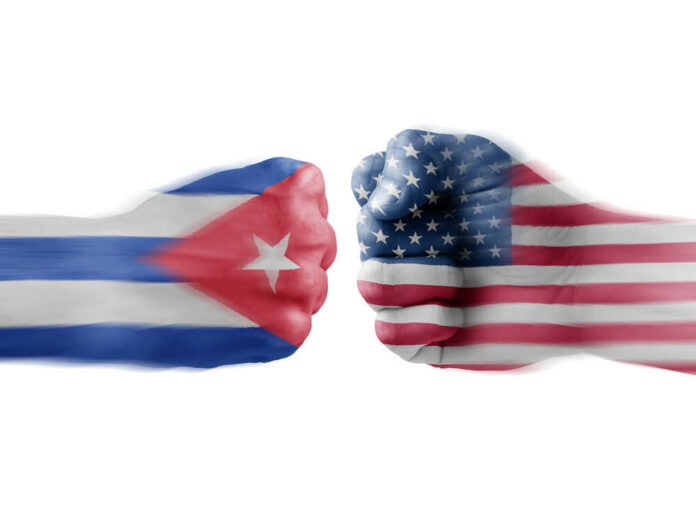
A deadly firefight involving a Florida-registered speedboat off Cuba is testing how the Trump White House responds when Americans may be caught in the crosshairs of a hostile regime’s narrative.
Story Snapshot
- Cuba claims its border guard troops killed four people and injured six others aboard a Florida-registered speedboat after the occupants allegedly opened fire.
- The incident occurred near Cayo Falcones, about one nautical mile northeast of the El Pino canal, and left one Cuban commander wounded.
- U.S. officials and lawmakers are demanding clarity because the identities and nationalities of those on the boat have not been confirmed.
- Florida Attorney General James Uthmeier ordered state prosecutors to coordinate with federal partners to investigate the shooting and boat’s origins.
What Cuba Claims Happened Off Cayo Falcones
Cuba’s Interior Ministry says border guard troops detected a “violating” speedboat in Cuban territorial waters Wednesday morning and moved to identify it near Cayo Falcones, on Cuba’s north coast in Villa Clara province.
Cuban authorities claim the occupants opened fire during the stop, injuring a Cuban commander. Cuba says its troops returned fire, killing four people and injuring six more aboard the speedboat, and evacuated the wounded for medical attention.
U.S. outlets report the boat was registered in Florida, identified by Cuba as FL7726SH, though public confirmation of that registration is limited because those records are not broadly accessible.
The lack of independently verified details matters because Cuba’s account is currently the only detailed narrative about who shot first. No U.S. eyewitness footage or third-party reporting from the scene has been presented in the initial coverage, leaving major questions unresolved.
Who Was on the Boat—and Why That Question Is Explosive
U.S. officials have not confirmed whether any of the dead or injured were American citizens, even as some lawmakers publicly suggested Americans were involved. Florida Rep. Carlos Giménez called the event a “massacre” and demanded a U.S. investigation into the victims’ status.
Rep. María Elvira Salazar said she is closely monitoring developments. Vice President JD Vance said the administration is watching the situation and hopes it is not as bad as feared.
BREAKING: Four people are dead and 6 others injured after a confrontation between a Florida-registered speedboat and Cuban border authorities in Cuban territorial waters, according to a statement posted by the Cuban Embassy to the United States on X. https://t.co/feeXwYLRoA
— NBC Montana (@NBCMontana) February 25, 2026
Democratic Rep. Adriano Espaillat said at a press event that four Americans were killed, but the available reporting still describes identities as unknown and unconfirmed.
That gap is not a minor detail; it is the difference between a tragedy involving foreign nationals and a major incident involving Americans killed by a communist government 90 miles from Florida. Until names and citizenship are verified, responsible analysis has to stick to the confirmed facts.
Why Florida Officials Are Moving Faster Than Washington
Florida Attorney General James Uthmeier directed state prosecutors to begin investigating and to work with federal partners. His public comments reflect deep distrust of the Cuban regime, which is understandable given Cuba’s long record of propaganda and tight control of information.
At the same time, the legal and diplomatic tools that can compel answers—consular access, State Department engagement, and potential sanctions—sit largely with the federal government, not Tallahassee.
The Bigger Backdrop: Smuggling Routes, Migration Pressure, and a Harder Line
The Florida Straits have a long history of illicit maritime traffic tied to migrant smuggling, drug trafficking, and political activism. Reporting notes that Cuba’s economic crisis and Florida’s proximity can fuel risky crossings, while past clashes have involved seizures of boats and cargo.
NPR also highlighted that passenger gunfire in these kinds of encounters is rare in recent history, which makes Cuba’s claim about the speedboat opening fire a key point that needs verification.
U.S.-Cuba cooperation on issues like drug smuggling and related crimes has been strained, and recent policy friction has grown as the Trump administration tightened pressure on hostile regimes in the region.
That broader context helps explain why this incident is instantly political: Havana wants to frame it as sovereignty defense, while U.S. officials must determine whether a hostile government used force appropriately—or whether the story is being shaped to justify lethal action.
What’s Known, What’s Not, and What to Watch Next
Three core facts are consistent across the initial reports: four people on the speedboat were killed, six were injured, and one Cuban commander was wounded during the exchange near Cayo Falcones.
Beyond that, key elements remain unproven: who initiated gunfire, who the passengers were, and what they were doing there. Cuba says an investigation is underway, but credibility hinges on transparency that the regime rarely provides.
For Americans who care about national sovereignty and the rule of law, the priority should be verified identities and a clear chain of evidence—not narratives built for TV.
The Trump administration’s next steps will likely depend on whether U.S. citizens were involved and whether consular access or independent verification is possible. Until then, this story is a reminder that the maritime border is not an abstraction; it is a real front line where policy, security, and human lives collide.
Sources:
Cuba says it killed 4 people on speedboat from Florida who opened fire off Cuban coast
Cuban forces shoot 4 dead on US speedboat from Florida, authorities say
Cuba says it killed 4 people aboard a Florida-registered speedboat who fired on soldiers
Cuba says it killed 4 people aboard a Florida-registered speedboat who fired on soldiers