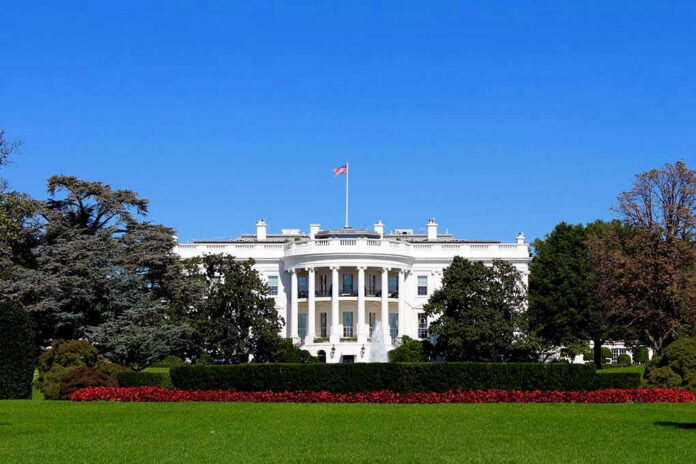
The White House is swatting down pardon chatter for convicted child trafficker Ghislaine Maxwell—after her own legal team put the idea back in play.
See the videos below.
Quick Take
- Press Secretary Karoline Leavitt said a Maxwell pardon is “not a priority” and hasn’t been recently discussed with President Trump.
- Maxwell’s lawyers referenced a possible pardon in a recent deposition/testimony, reigniting media pressure on the administration.
- Maxwell is serving a 20-year sentence for child sex trafficking connected to Jeffrey Epstein’s abuse of minors.
- Trump previously said in 2025 he would “take a look” at a pardon request, creating a contrast with today’s White House messaging.
Leavitt’s Message: No Focus on Clemency for Maxwell
White House Press Secretary Karoline Leavitt told reporters on February 10, 2026, that pardoning Ghislaine Maxwell is “not a priority” for President Donald Trump. Leavitt said she has not discussed the topic with Trump recently and that, the last time it came up, Trump indicated it was not under consideration. The briefing placed the administration’s position on the record while stopping short of a permanent, formal rejection.
Leavitt’s answer matters because the president’s pardon power is broad and discretionary, and the press corps is treating Maxwell as a political flashpoint rather than a routine clemency question.
Conservatives who have watched years of selective outrage from legacy media can recognize the pattern: the same institutions that ignored border chaos and cultural radicalism now fixate on a scandal-driven narrative. Even so, the underlying facts of Maxwell’s crimes make clemency talk uniquely combustible.
Why the Question Resurfaced After a Deposition Reference
The renewed controversy stems from Maxwell’s legal team referencing a pardon during a recent deposition/testimony on February 9, 2026. That timing created a direct pipeline into the next day’s White House briefing, where reporters pressed Leavitt for clarity.
The sequence also landed amid an intense public push—especially from grassroots conservatives—for transparency around Epstein-related files and networks, with many Americans wanting answers about who enabled abuse and who was protected.
Available reporting indicates Maxwell remains incarcerated following a 2025 transfer to a lower-security federal prison camp in Texas after Justice Department interviews tied to Epstein associates.
The public record summarized in the provided research does not include a new presidential statement after the February 2026 developments, leaving Leavitt as the administration’s most current voice. That vacuum is exactly what fuels speculation, particularly when Maxwell’s team appears eager to keep clemency rumors alive.
Q: “On Ghislaine Maxwell, is the president going to rule out a pardon for her?”
Leavitt: “Again, this is not something I've discussed with the president recently because frankly it's not a priority.” pic.twitter.com/i88W8shoL4
— The Bulwark (@BulwarkOnline) February 10, 2026
Maxwell’s Conviction and the Political Stakes of a Pardon
Maxwell was sentenced in June 2022 to 20 years in federal prison for child sex trafficking for helping Jeffrey Epstein abuse minors. The case involves grooming and exploitation stretching across the 1990s and 2000s, a reality that makes any pardon discussion politically radioactive.
For many voters—especially parents and grandparents—this is not abstract politics. Any perceived softening toward a convicted trafficker risks undermining confidence that elites are held to the same standards as everyone else.
The same research notes Trump had social exposure to Epstein and Maxwell in past decades, while also claiming he banned Epstein from Mar-a-Lago for being a “creep.”
Those facts are frequently used to build insinuations, but the documented point in this update is narrower: Leavitt is emphasizing priority and present-day focus, not relitigating every historic allegation. Still, because the crimes were horrific, the administration’s posture must be unmistakably aligned with justice for victims and accountability for facilitators.
Mixed Signals: 2025 “Take a Look” vs. 2026 “Not a Priority”
The tension in this story comes from contrasting public signals. In July 2025, Trump acknowledged that a pardon request existed and said he would be “allowed” to consider it and would “take a look,” with consultation from the Justice Department.
Leavitt’s 2026 phrasing downshifts the issue—“not a priority”—while leaving observers room to argue nothing is fully off the table. That ambiguity is why the story continues to churn.
Separately, Leavitt also faced questions tied to a resurfaced claim about a 2006 call involving the Palm Beach police and Epstein, which she did not confirm.
The limited, recent source set in the provided research leaves uncertainties around older details, but it clearly shows the current political dynamic: reporters keep pulling the administration toward Epstein-related controversy while the White House tries to steer back to broader governing priorities.
For conservatives, the takeaway is simple—demand transparency and accountability, but don’t let media obsession displace the policies voters elected Trump to deliver.
Leavitt: Pardoning Maxwell 'Not a Priority' for Trump https://t.co/89Fdjoqeuq
— ConservativeLibrarian (@ConserLibrarian) February 10, 2026
For now, the only firm update is procedural and political: Maxwell remains imprisoned, her legal team continues to float clemency, and the White House says it isn’t focusing on a pardon. Until Trump speaks directly or a formal clemency action appears, the story will be driven by press briefings, legal maneuvering, and demands for disclosure.
The administration’s challenge is to keep the constitutional clemency process from becoming a tool for spectacle—while ensuring victims’ interests and public trust are not sidelined.
Sources:
donald-trump-plays-dumb-ghislaine-maxwell-pardon