

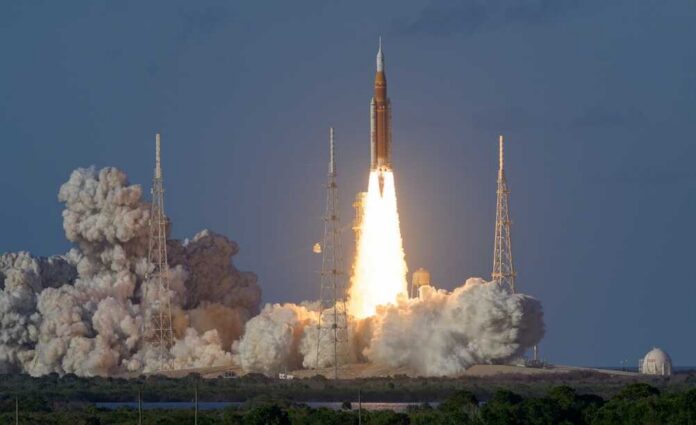
NASA just named four people who will ride the biggest rocket on Earth to rehearse the next American return to the moon.
Story Snapshot
- NASA introduced the four-person Artemis III crew that will fly a key test mission before future moon landings.[2][6]
- The mission will not land on the moon; it will practice docking with new commercial landers in Earth orbit.[2][6]
- Veteran astronaut Randy Bresnik will command a team that includes Italian pilot Luca Parmitano and NASA specialists Andre Douglas and Frank Rubio.[2][4]
- This crewed test flight in 2027 is a make-or-break step to prove the system works before America risks lives on a lunar landing.[2][6]
NASA finally puts real faces on its next big moon step
NASA spent years talking about Artemis in charts, slides, and budget fights, but a program does not feel real until real people strap in. That moment just arrived.
The agency named four astronauts to fly Artemis III, the follow-up to Artemis II and the dress rehearsal for America’s next moon landing push.[2][6] The announcement came live from Johnson Space Center in Houston and echoed across news networks and social media in minutes.[3][5]
Congratulations to the newly announced crew for Artemis III! We are thrilled that these four distinguished astronauts will be “carrying the fire” for our next mission toward establishing a long-term human presence on the surface of the Moon. https://t.co/9RbDm8TaWF
— NASA History Office (@NASAhistory) June 9, 2026
The crew list sends a clear message about what this mission is and what it is not. Artemis III will launch four astronauts on the Space Launch System rocket in the Orion spacecraft from Kennedy Space Center in Florida, but it will stay in low Earth orbit.[2][6]
There will be no flags planted and no boots on lunar dust on this flight. Instead, the crew will test the risky part that must work before any landing: docking Orion with commercial-built human landing system vehicles.[2][6]
Meet the four astronauts carrying the program on their backs
NASA assigned veteran astronaut Randy Bresnik as commander of Artemis III.[2] He has flown before and brings combat pilot grit plus long-duration space station experience.
European Space Agency astronaut Luca Parmitano, from Italy, will serve as pilot, making this another deep partnership mission between the United States and Europe.[2][4] Rounding out the team are NASA astronauts Andre Douglas and Frank Rubio as mission specialists, both engineers trusted to handle complex systems and spacewalk training.[2][4]
This mix is not an accident. NASA and the European Space Agency want a crew that can handle intense test work, not tourist selfies. The mission will ask them to rendezvous and dock with early versions of two very different human landing systems: SpaceX’s Starship and Blue Origin’s Blue Moon.[2][4]
These vehicles will launch separately, and the crew will approach, dock, move through hatches, and evaluate life support and space suit operations in weightlessness.[2][4][6] That sounds routine on paper, but any failure in these steps later, near the moon, could cost lives.
Why this “no landing” flight still matters for the moon race
Artemis III looks modest compared with Apollo 11 on the surface. No moonwalks, no dramatic surface photos, just a two-week stay in Earth orbit while systems get tested.[2][6]
But this is the part that separates a PowerPoint program from a real one. The mission will prove whether the giant commercial landers and NASA’s Orion and Space Launch System can work together as one system.[2][6] Only after that will NASA send crews to repeat the same dance near the moon, then commit to a landing.
This approach fits a step-by-step mindset that many taxpayers prefer, even if politicians like splashy firsts. NASA already slipped the original plan for Artemis III, which was once billed as the first landing of the program, after delays and technical risk grew too large.[2]
Critics online argue the agency should not announce crews until landers and dates are locked in, but that view ignores how big, complex programs work. Crew selection is part of building real hardware and training; it is not a campaign slogan.
What this says about America’s space priorities and partners
Artemis III also shows where the United States wants to plant its flag in the twenty-first century space race. Instead of doing everything in-house, NASA is leaning on private firms for landers and on allies for key hardware, like Europe’s service module and Luca Parmitano’s role as pilot.[2][4][6]
That kind of burden-sharing respects both budget reality and the idea that free nations work better as a team than as lone heroes.
🚀 𝐍𝐀𝐒𝐀 𝐣𝐮𝐬𝐭 𝐫𝐞𝐯𝐞𝐚𝐥𝐞𝐝 𝐭𝐡𝐞 𝐀𝐫𝐭𝐞𝐦𝐢𝐬 𝐈𝐈𝐈 𝐜𝐫𝐞𝐰.
Meet the astronauts preparing for humanity's next giant leap:
👨🚀 Randy Bresnik – Commander
👨🚀 Luca Parmitano – Pilot
👨🚀 Andre Douglas – Mission Specialist
👨🚀 Frank Rubio – Mission Specialist
But here's… pic.twitter.com/bXGTZl1ggJ— Astrobitica (@Astrobitica) June 9, 2026
For Americans who care about national strength and smart spending, this mission is a test beyond rockets. If Artemis III flies in 2027, proves docking with commercial landers, and brings its crew home safe, it will show that large public–private projects can still deliver.[2][6]
If it stumbles, critics who say Washington talks big and delivers small will gain more fuel. Four astronauts now carry that weight, along with the hopes of anyone who wants their country to lead on the high frontier, not watch from the couch.
Sources:
[2] Web – Artemis III – Wikipedia
[3] Web – NASA to Announce Artemis III Crew, Provide Mission Progress Update
[4] YouTube – NASA reveals the new Artemis III crew
[5] YouTube – Artemis III announcement: Luca Parmitano assigned as pilot
[6] Web – Our Artemis II Crew – NASA