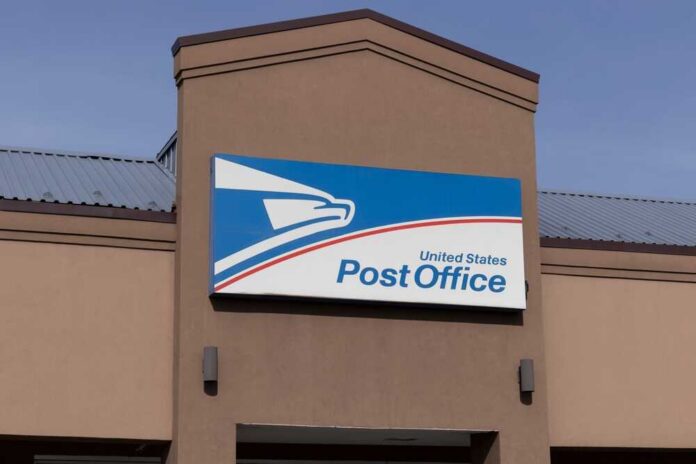
USPS just told states it will not move a single federal ballot through the mail unless each envelope carries a unique barcode tied to a named voter, logged in a federal portal.
Story Snapshot
- USPS published rules for federal-election ballot mail with serialized barcodes and a new portal.
- States would submit voter names, addresses, and barcode-linked ballot data before mailing.
- USPS says the data allows verification, tracking, and law-enforcement support.
- Supporters call it a necessary chain of custody; opponents say it is federal gatekeeping.
What USPS Actually Put On The Table
USPS proposed, then finalized for publication, a rule that tightens the process by which federal mail ballots enter the mail stream. States would enroll in a Federal Ballot Mail Portal and use a unique serialized Intelligent Mail barcode on outbound and return ballot envelopes.
Before acceptance, states would upload the voter’s name, address, and the barcode linked to that ballot. USPS frames this as logistics plus accountability: track each ballot, verify list alignment, and reduce errors or abuse.
The United States Postal Service has released a new rule adding verification requirements to all mail-in ballots. https://t.co/How6zwugny
— ABC News (@ABC) August 23, 2026
The new standards sit atop long-standing election-mail rules. USPS has, for years, set the formats, markings, and handling for official election mail. Publication 632 and related standards instruct officials on design and processing so letters move cleanly through automation.
The barcode-and-portal layer goes further than envelope design. It builds identity-linked tracing into acceptance itself, which is why some see it as a modest extension and others see a new gate at the mailroom door.
Why USPS Says It Needs Names And Barcodes
USPS argues that unique barcodes matched to a voter record allow it to check compliance with federal law, spot anomalies, and support law enforcement if needed. The data also improves visibility into where ballots are and whether they were transmitted to the right people.
A news outlet reported the service’s view bluntly: serialized barcodes and list matching “will help determine adherence to federal law and facilitate law enforcement efforts.” That is a clear security and compliance claim, not just convenience.
The logic tracks with chain-of-custody. You cannot audit what you cannot count. When each ballot has a serial and a named addressee confirmed before entry, you reduce misdirected mail, duplicate sends, and sloppy records.
That said, the surfaced record does not show USPS producing a study that proves barcode-list matching stops large-scale fraud. The claim is practical, but the measured lift in accuracy or deterrence remains to be shown in data.
What Supporters And Critics Are Really Arguing
Thirteen Republican attorneys general praised the rule as standardizing envelopes and adding unique barcodes to tighten the chain of custody. They said these steps address real gaps in mail voting, which aligns with priorities on traceability and clear rules.
On the other hand, a group of 24 attorneys general, led by Minnesota’s top lawyer, called the plan an overreach that helps President Trump “seize control” of elections. That is a strong political charge, not a technical rebuttal.
The USPS Published its Mail-In-Ballot Rules For the Midterm Elections…This is HUGE.
The USPS just published a new rule implementing Trump’s executive order on mail-in ballots.
States that want the Postal Service to handle their mail-in or absentee ballots must now:
-Turn… pic.twitter.com/EuVuak4Stk
— Americaforever (@onetexgal9) August 23, 2026
Representative Raja Krishnamoorthi warned that portal registration, 30-day list uploads, and barcode matching would turn USPS into a gatekeeper over who gets a ballot. He argued that role belongs to states and Congress. Also, it summarized the mechanics in the same way, but without the rhetoric: states would enter voter names and addresses, each tied to a unique barcode, into a federal portal before USPS accepted those ballots. That confirms the function, not the motive.
The Catch: Courts, Clocks, And Cost
USPS has posted the final rule but tied action to court clearance. Reuters reported the service will not implement absent a court’s go-ahead, which means timelines are at risk. States say they lack time to retool systems or print new envelopes before elections.
The surfaced record also lacks a public cost-and-burden model. Even a sound rule can fail if it arrives late, demands new tech, and offers no glide path. Lawsuits and calendars may decide fate more than theory.
Two questions will shape what comes next. First, does federal postal law let USPS require identity-linked lists as a condition of acceptance for federal ballot mail?
Second, does list-and-barcode verification add value beyond existing steps such as registration checks and signature or identification verification when ballots are returned?
USPS has an operational mandate for mail standards. Whether that extends to pre-mail eligibility screening, even if only procedural, is a question the courts will resolve.
How To Judge The Tradeoffs Like A Grown-Up
Ballot security and ballot access are not enemies. Systems can do both when roles are clear and data is protected. The case for the rule is straightforward: serialize each envelope, tie it to a voter, and log it before it moves.
That gives auditors a clean trail and gives the public a reason to trust the mail. The case against is also plain: new federal data pipes, new chokepoints, and the risk that a postal rule crowds state authority if it conditions service.
A serious compromise looks like this. Keep unique barcodes and portal enrollment for transparency. Limit the uploaded data to the minimum needed for tracking. Publish retention limits and access controls.
Offer states implementation funding and a phased schedule tied to election calendars. If USPS proves, with data, that serialized tracking cuts errors and speeds cures for voters, most people will support it. Trust grows when proof beats promises.
Sources:
abcnews.com, app.govly.com, reuters.com, grayhairsoftware.com, about.usps.com, nwlc.org, nul.org, usatoday.com, krishnamoorthi.house.gov, content.govdelivery.com